One of Lacan’s famous diktats is that the unconscious is structured like a language. In this view Lacan transposes linguistic structure onto the logic of the unconscious; the elements of Freud’s primary process—the dream logic of condensation and displacement—are translated into the literary tropes of metonymy and metaphor. We can read the figures of the unconscious—read a symptom, or a dream—because we know how to read poetry, is basically the idea here; and one that had been meticulously laid out in The Interpretation of Dreams. With the hermeneutic kit provided by psychoanalysis we can take the seemingly indecipherable dream image—or a scene from the patient’s life—and translate it using the application of metaphor. Kafka did as much in reverse when, after reading the Interpretation of Dreams, he transduced humorous-nightmare stories from his own hypnagogic trance.
In the meantime, for Lacan, the unconscious itself is displaced. No longer inside and down, as in Freud’s drawing, it is now outside and everywhere. It is the “discourse of the other” and is extimate to the psyche (or the psyche is extimate to the body). The unconscious flips from being a kind of interior container, seat of the drives, and a “seething cauldron,” to now being, according to Lacan, a very legible repression undulating upon the surface of discourse. This flip is like one of those optical illusions that, once you see it, you can’t unsee. Like those seeing-eye books of my childhood, it took me a long time to actually conceptualize Lacan’s unconscious and, I hazard to guess, it provides a kind of barrier for that person familiar with conventional psychoanalytic theory—for it, quite literally, turns that theory inside-out.

In order to keep fantasy and reality opposed, Freud finds it necessary to locate the unconscious well away from perception, as is shown in this drawing from 1923. What remains curious to me, is that the unconscious wears “a cap of hearing,” what is that about ?
For Freud, as you can see in his drawing, the unconscious is inside. Freud himself had used the term depth-psychology, that relates no doubt to his notion of psychical locality, that the “apparatus of the soul” is arranged according to sequence, with the unconscious being last and most interior. But though Freud often refers to the unconscious as a container, as a reservation, it is likewise true that one can find Lacan’s extimate psyche here in germ form, in papers such as The Uncanny (1919), and Negation (1925) and in the very notion of repression, thus making a sea-change that I would name the hermetic-turn; that is, the turn from an exoteric psychology to an esoteric psychoanalysis.
On the one hand we can only make sense from where we are at, which is smack-dab deep inside a language that, like Pascal’s frightful sphere, has a circumference that is nowhere, and a center that is everywhere—especially exactly where you are. Derrida’s bon mot, that there is nothing outside of the text, is a fair approximation of our neat confinement to the symbolic—and thus to the unconscious. The most clear example of this is our own infantile amnesia, that black box of psyche; whereof we cannot speak, we can’t remember either. So for example, a certain kind of Lacan would find it absurd that Terence McKenna would speculate the origins of language, because such mythical origins are precisely outside of language.
I say a certain kind of Lacan, because Lacan himself speculated hard upon the black box of the infans in his great disposition on The Thing, in the seventh seminar of 1959-60. The Thing is a provisional holdover from Freud’s thing-presentation, for whom, in fact, there is a world outside of language (for Freud, thing-presentations precede word-presentations). As Lacan so provocatively describes it, The Thing of infantile amnesia, like the Ein-Sof God of kabbalah, is an empty vase, a teeming void; what can only be represented later on by nameless dread, by the sublime, by the sacred and by the very limits of an art-object that aspires to “the dignity of the thing.” Curiously, Lacan will leave this concept behind and rarely, if ever, mention it again; the pre-linguistic Thing becomes the superlinguistic objet petit a.
Here again, in the move from das ding to objet petit a, we can find that same flip of displacement from an occult and primordial container beyond the realm of thought, to being anywhere and everywhere visible and obvious—if you know what to look for.
I remain bewitched by these Lacanian displacements as much any reader, and yet—on the other hand—this focus on the exterior and the surface would seem to neglect the all-too-interior and secretive products of fantasy and dream, topics that do not appear very often in Lacan’s discourse… It can seem at times that Lacan’s unconscious is perfectly adapted to his own talents of extreme literacy… As if he had invented an unconscious for whom he is the best reader.
A question I’ve wondered for a while now: instead of the unconscious being structured like a language, why is not language structured like a dream?
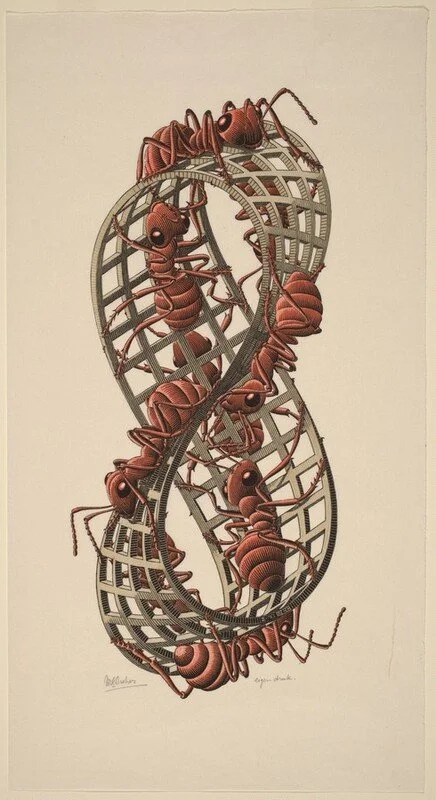
Mobius Strip II, 1963, M.C. Escher