Just Not Thinking About It: Disavowal, Positive and Negative
In the 2006 movie Children of Men, which takes place in 2027 and which depicts a bleak vision that our own world appears to be catching up with right on time, Clive Owen visits his wealthy cousin, Danny Huston, who lives in the Tate Modern and who has Guernica on his dining room wall. Clive Owen asks him how he can be so invested in saving artwork when, because of the universal infertility that afflicts the world, in a hundred years no one will be around to look at it anymore. Danny Huston replies with a wolfish grin: “I just don’t think about it.”
For a long time this remark struck me as the kind of myopic callousness that only the rich can afford. I have since come to realize, however, that we all do this, all the time; I’ve realized, in fact, that just not thinking about it is one of the more handy modes of defense for life here on planet earth.
Psychoanalysis has an array of terms for this mode of unthought and unknown mental stuff that nevertheless determines thought in the last instance. Whether repression, where a feeling or desire is made totally unconscious, or disavowal in which what has been disavowed remains within the realm of the known but is actively expelled from conscious thought, or just plain denial. For Freud, disavowal is the first step on the shining path of psychosis; the flat disavowal of reality.
The most obvious example of disavowal, that we may all experience, is the fact of one’s own mortality. I know very well that one day I must die, but I just don’t think about it! Or another example: though I am well aware of all the homeless people outside my door, I really try not to think about them because I want to believe in a just and fair society, as I am just and fair. I know that climate change is making the planet uninhabitable, but all the same, I don’t want to think about it, okay!?
Notice that these positions are reasonable, as in it is reasonable to not think about my immanent death all the time, and yet, at the same time, they are a willful occlusion of a rather glaring fact. We occlude the fact because it is traumatic. Once lifted to the scale of society this can pose rather intractable problems, as we can see in the matter of the unhoused, and ecological collapse. Everyone knows that the climate is warming, since like the 80’s, but let’s drill the ocean floor for oil all the same! The frog practices the art of disavowal when they notice that the water is getting hotter, but decide to remain focused upon profit margins. Anyways, other frogs will boil first.
But it also seems to me that we are reaching a point in world history where just-not-thinking-about-it doesn’t work as well as it once did, where the various paroxysms we are experiencing—the so called poly-crisis, or Jackpot—is due in part to the various things that had once been successfully disavowed—whether state-violence, economic precarity, war, or environmental collapse—are all encroaching on our fantasy. We have reached the point where the fantasy can only be maintained through the use of force by corrupt and demented real-estate politicians and their hate-filled media campaigns.
On the other hand, I will admit that I, who am powerless in the face of these encroachments, allow myself to function at a very practical day-to-day level by practicing the art of-just-not-thinking-about-it, mixed with a good dose of dayglo fantasy. Rather than be blinded by the excoriating light of absolute history I intentionally practice the art of forgetting and draw a limited horizon about myself—in order to be able to think. I am only human after all. I think that this is some of what Audre Lorde means by self-care.
Of course this is harder to pull off when what is being disavowed is kicking your door in. I once had a coworker who in their spare time, following the summer of 2020, would actively seek out and watch videos of cop-brutality. I, who avoid such videos whenever possible, marveled at this strange habit; It reminded me of the reconditioning scene in A Clockwork Orange (1972) when Alex is forced to watch the Catastrophe of the 20th century.
Probably disavowal, in its positive mode, functions as a protective shield in the manner of space craft on Star Trek. The shield requires energy, and can be turned on or off, should the energy be required elsewhere, as in the firing of phasers or in scientific research; aware that the shield occludes sensitivity and vulnerability, I turn the shield off to sample the environment.
But while just-not-thinking-about-it is a common defense, unlike repression it is not default, nor is it the only kind of defense, but rather one defense among many. It may even be categorized as a mode of attention, and can be contrasted to other modes such as evenly suspended attention, that particular kind of attention specific to psychoanalytic treatment. Outside of the treatment this kind of attention is known as neutral or bare attention and it is a much superior mode of engaging with the world than that of just-not-thinking-about-it; if you can handle it. In this mode one attempts to keep the field of one’s awareness as wide open as possible without judgement, or negation or becoming fixated on anyone thing; for nothing is good or bad but thinking makes it so.
Yet another mode opposed to disavowal is that of enthusiasm. A mode that was once defined as being possessed by a god, I would now re-define this ecstatic state as being possessed by that which is other than yourself. As we have been exploring on this channel there are a whole host of techniques by which enthusiasm may be achieved.
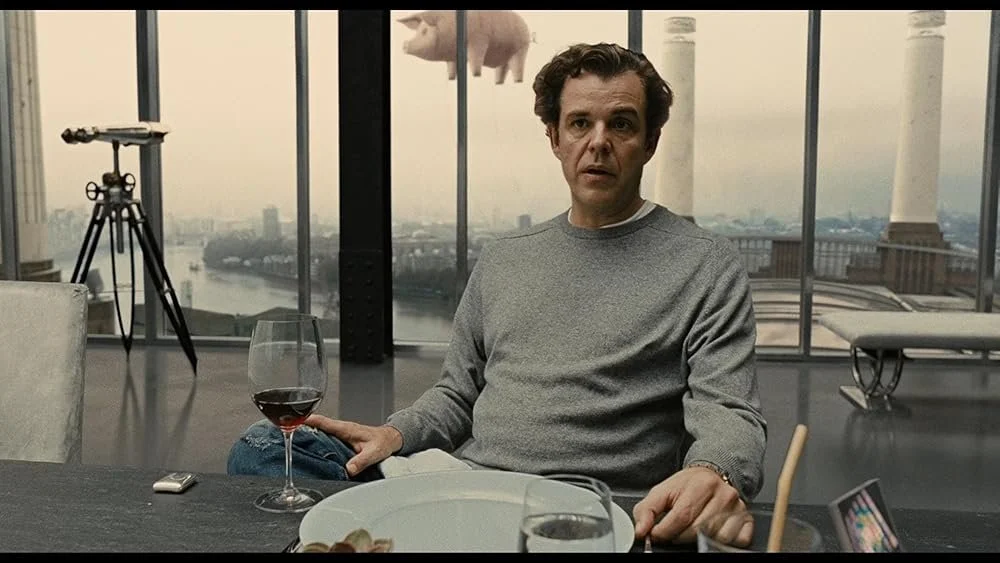
Danny Huston in Children of Men, 2006
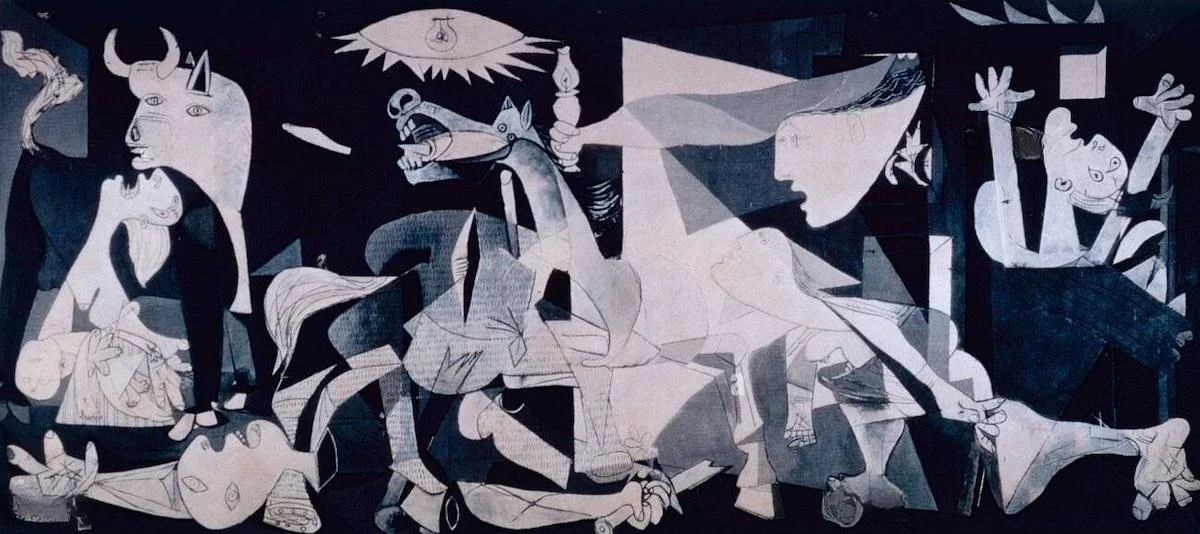
Guernica, 1937