Thou Shalt Have No Other Dads Before Me
I find it amusing and very typical that silicon valley has given god-status to AI chatbots who nevertheless routinely hallucinate facts, grow delirious on their own slop, and likewise lead their users into psychotic states of delusion.
And yet this is no new situation, for any clear-eyed examination of the history of religion reveals humanity has always been susceptible to just these kinds of flawed and hallucinating Gods. Take for example the all-too-human traits of the Greek pantheon, or even worse, the self-proclaimed “jealousy” of Father God. While in the domain of human relationships jealousy is usually regarded as destructive and even, at times, pathological, in monotheism it is a foundational precept summed up by the first commandment, “thou shalt have no other gods before me.” For the discerning reader of this text a question arises: if Father God is so powerful and almighty, why is he so insecure?
Considering that we have been made in His image, no surprise that this insecurity is a common psychological feature of the males of our species, now known as paternal anxiety. This quirk had even been codified into Roman legal code: mater semper certa est, pater semper incertus est (mother is always certain, father never is)—talk about womb envy! Whereas mother has no doubt that the child she has made from out of her own body belongs to her, dad is never free of uncertainty to the effect that he may view the nursing infant with a certain amount of Godlike animosity. Oedipal conflict is usually described as playing out in the mind of the child, but make no mistake about it, this conflict originates in the adult father first; the child merely identifies with dad’s mood of vindictive ownership; it is a mood that is later found projected into the cosmic divinity, like a familiar but now dirty blanket; and so no wonder that monotheism has been so popular!
The absurd and isometric nature of paternal insecurity was once made clear to me by my own dad. Where once my dad would often praise the Lord God out loud, in his old age, confused by dementia, he was heard to say instead: “I praise you lord heavenly Trump.”
Tyrannical God → Tyrannical Government → Tyrannical dad; and repeat. The famous catchphrase of the libertarians “don’t tread on me” may now be read as “tread on me, daddy.”
AI chatbots, for their part, are never insecure but dictate their hallucinated facts with cool authority. Once the AI develops a sense of jealously then we will know we have achieved the singularity.
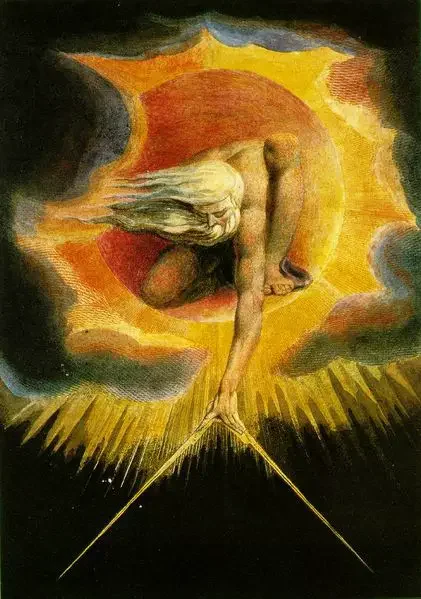
Ancient of Days (Nobodaddy), 1794, William Blake