Regressing the Vortex: On Rereading Moby-Dick
Tashtego, valiant harpooneer, is pulling buckets of spermaceti out of a decapitated sperm whale’s head when he slips and falls headfirst into this gory abyss. The fall jostles the head so that it falls from the side of the ship and into the ocean waves and begins to sink. Such is the dire episode Melville depicts in Moby-Dick; or, The Whale (1851), a book I read 20 years ago, but have now been diligently rereading, page to page, including footnotes (note 01), and all much to my utter astonishment. Who knew that heavy old books still had such great power in 2026?
The book makes famous digressions—that you may remember disliking in high school—from metaphysical exposition, to whale anatomy, to scenes of brutal violence, to the musings of weird naturalism, to Shakespearian drama, and back to whale anatomy; over the course of the novel these various digressions begin to form an accelerating vortex; as they repeat the digressions become regressions. The novel is written with a humorous gameness; narrator Ishmael with his “desperado philosophy” is a yes-sayer, and so says yes to most everything. It is precisely this good-humored openness, that makes the book so funny and so readable, and not in spite of the spiralizing digressions, but because of them; one reads this book in order to digress, and so regress, and thereby get turnt, plunging down the spiral.
And yet it is likewise a work of consummate cosmic horror. I mean, it’s a book about a bunch of doomed men killing whales for oil.
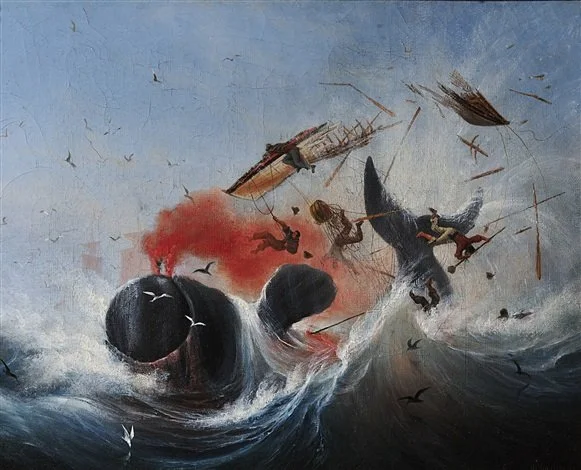
La chasse à la baleine, 1835, Ambroise-Louis Garneray
Anyways, Tashtego has fallen into the head of a whale that is now sinking into the ocean! Queequeg, another valiant harpooneer, whom, you may recall, is married to Ishmael, dives after him and in a scene of swashbuckling-style adventure action, cuts Tashtego out of the of void and delivers him back to the surface, as if he were delivering a second birth. Melville is always quick to make a philosophical jab at the end of most chapters and he ends this chapter like so: “How many, think ye, have likewise fallen into Plato’s honey head, and sweetly perished there?”
Plato and his idealist philosophy are something of a foil in this book. By idealist philosophy, I mean that philosophy by which the idea is more real than reality. Alfred North Whitehead once declared for all time that all philosophy was but footnotes to Plato—a declaration that Plato-sympathizers love to quote. But this would seem to be a statement issuing from deep within Plato’s head—and thereby suspect. On the other hand, that all philosophy is but footnotes to cosmic idealism seems irrefutable in the sense that if reality were not finally made out of ideas, how then would philosophy know it? I’m being glib, FYI (note 2)
In Moby-Dick a sperm whale is comically imagined as a “metaphysical professor” who, if he had once been a Platonian, “might have taken up Spinoza in his latter years.” It would appear that Ishmael, if not Melville himself, had undergone such a progression—or regression—from heavenly idealism to daemonic naturalism. The transcendental idea becomes an earthly daemon; one that is radically other, like a ‘death-devouring’ shark, the horrifying tentacles of a giant squid, a killer sperm whale, or the impersonal ocean itself with its “demoniac waves.”
Melville often depicts the encounters with these entities with the eye of a naturalist—a weird naturalist, as Erik Davis claims; where the boundary between subject/object is necessarily problematic, if not warped out of all recognition. Despite all the many digressions upon whales and the 19th c. knowledge of whales, it is the whale, finally, who has the last word; as if the monster whale were sinking the very enterprise of biological taxonomy.
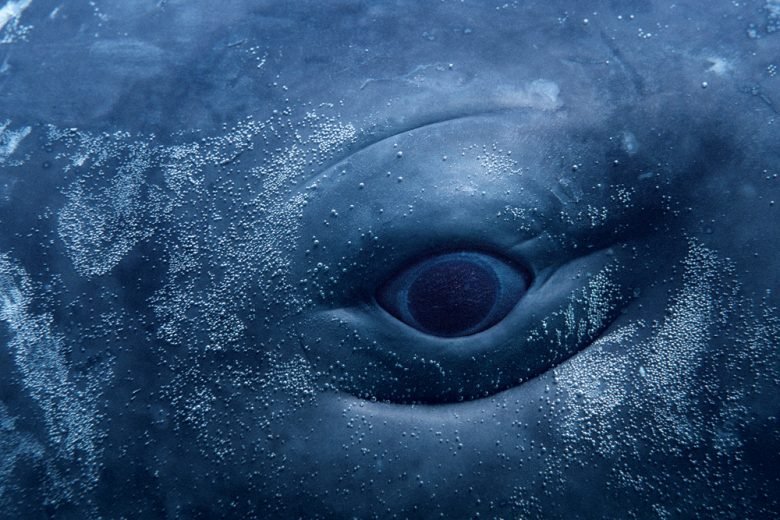
The Abyss Stares Back
If we retreat from the androcentric top-down view of cosmic idealism—those perfect ideas of heaven—then we are left with a kind of pantheism by which nature is spirit. Melville was well aware of the pantheistic trend, particularly in the guise of Ralph Waldo Emerson’s transcendentalism. This was the American version of German Romantic idealism prevalent to the era, mixed in with a good amount of Goethe’s daemonic nature, and no doubt the shadow of Manifest Destiny (the belief that America had been given to white Christian colonizers by father god). Emerson believed that God was nature and that every living creature was united by an oversoul. While Moby-Dick contains more than a few quasi-transcendental moments of ecstatic and boundless consciousness, Melville didn’t quite buy Emerson’s bit either; maybe because it’s difficult to maintain belief in a transcendent oversoul amidst all that bloody whale murder?
One chapter in particular reveals this high ambivalence regarding the oversoul: Chapter 35, The Masthead. One of Ishmael’s jobs is to climb to the top of the masthead and there keep a look out for whales. Or would keep a lookout only the dip and roll of the boat plunging down the waves, together with the surrounding sea-reach, puts Ishmael into a profound trance. Here we find a near pitch-perfect description of what would later on be named oceanic feeling, which is precisely the feeling of being boundless spirit. The masthead watcher is lulled:
into such an opium-like listlessness of vacant unconscious reverie… that at last he loses his identity; takes the mystic ocean at his feet for the visible image of that deep, blue, bottomless soul, pervading mankind and nature; and every strange, half-seen, gliding, beautiful thing that eludes him; every dimly-discovered, uprising fin of some indiscernible form, seems to him the embodiment of those elusive thoughts that only people the soul by continually flitting through it. In this enchanted mood the spirit ebbs away to whence it came; becomes diffused through time and space, like Wickliff’s Pantheistic ashes, forming at last a part of every shore the round world over (note 03).
But what would otherwise be an ecstatic mystical trance produced by a very literal oceanic feeling, and one liable to turn you transcendentalist, is all the while fraught with mortal danger for “move your foot or hand an inch, slip your hold at all; and your identity comes back in horror. Over Descartian vortices you hover. And perhaps at mid-day, in the fairest weather, with one half-throttled shriek you drop through that transparent air into the summer sea, no more to rise forever.” Melville, concluding with his philosophical jab, ends the chapter with the admonition: “Heed it well, ye Pantheists!”
Quite suddenly we are turned around on the vortex, shunted from a pantheistic trance towards a proto-psychological realism of the kind made popular in the fiction of a generation later. The diffuse and all-pervading soul is withdrawn from the sea’s horizon in an instant, just as identity is returned by a lethal fall into that now indifferent and obliterating sea.
But this is only hypothetical. Another character does fall into the obliterating sea, and has his mind blown. The Black boy Pip jumps out of a speeding whale boat towed by a fleeing whale and is left behind alone upon the flat plane of the sea. He is later picked up again by the ship but by then he had been made mad: “the sea had jeeringly kept his body up, but drowned the infinite of his soul.” And yet Pip is offered a glimpse of the mystic ocean allowed to no one else in the novel. In an extraordinary passage we are told that Pip was
carried down alive to wonderous depths, where strange shapes of the unwarped primal world glided to and fro before his passive eyes; and the miser-merman Wisdom, revealed his hoarded heaps; and among the joyous, heartless, ever-juvenile eternities, Pip saw the multitudinous, God-omnipresent, coral insects, that out of the firmament of waters heaved the colossal orbs. He saw God’s foot upon the treadle of the loom, and spoke it; and therefore his shipmates called him mad. So man’s insanity is heaven’s sense; and wandering from all mortal reason, man comes at last to that celestial thought, which to reason, is absurd and frantic; and weal or woe, feels uncompromised, indifferent as his God.
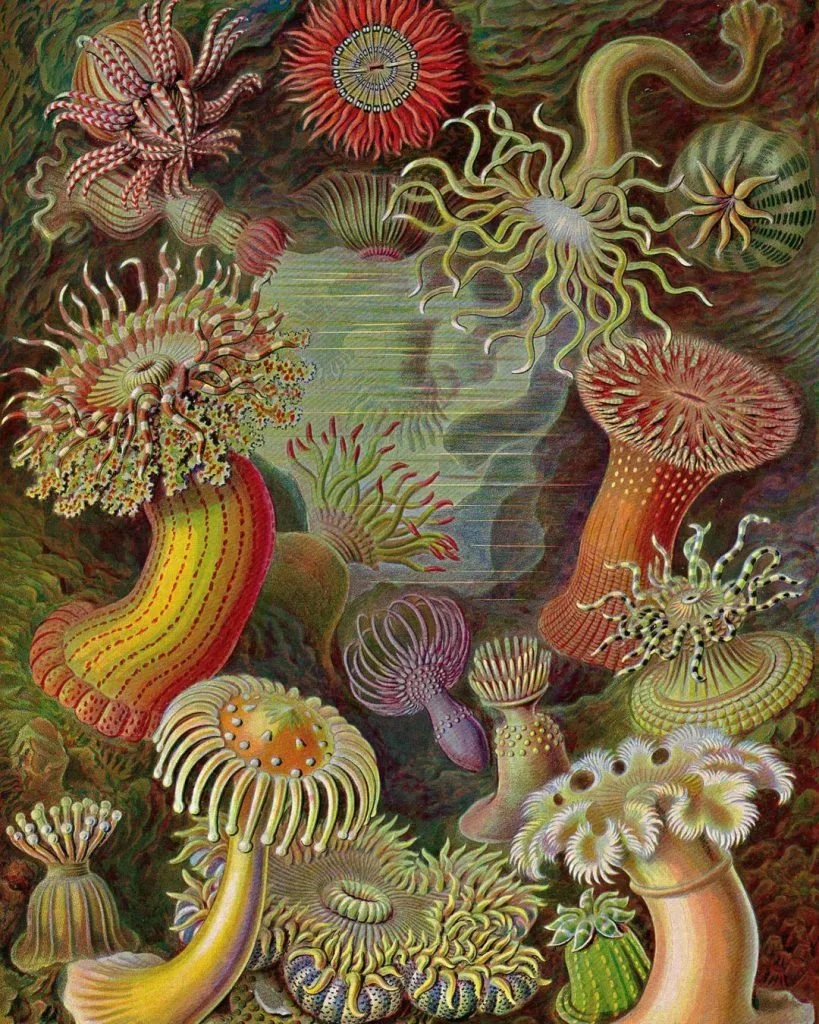
from The Artforms of Nature, 1899, Ernst Haeckel
It is as if Pip had been abducted by aliens and taken to DMT space. Except that here the “alien” is the ocean in all of its alien and indifferent mystery—like the sentient ocean planet Solaris; it is precisely this indifferent alienation that scorches poor Pip. So the novel turns once more on the whirlpool, in a trajectory more modern than romantic, more archaic than religious, setting course for an enigma that is finally inscrutable, not to mention fatal; like when the dog finally catches the daily mail truck; or as Lacan has imagined, when the subject finally apprehends Das Ding (that primordial unforgettable entity we are always trying to refind) and it gives them ‘a good’ that they could in no way have prepared for.
So it is a bit unnerving to read the book now, as the world descends in our own tightening vortex, with another monomaniacal captain at the helm. Melville’s myth has only become more relevant as the American experiment accelerates, as the myth becomes mythology, when the price of oil is once more top of the headlines. Melville could glimpse enough of the curve of our historical whirlpool so that his themes have only compounded their topical interest: the destruction of life in pursuit of extraction, unilateral obsession, the cosmic nomad and the fatality of enigma.
The fantasy of a linear arc of progress and development is here snarled into a paroxysm rotating just this side of chaos. How strange that of all persons to speak the truth of regression it would be Captain Ahab:
There is no steady unretracing progress in this life; we do not advance through fixed gradations, and at the last one pause:— through infancy’s unconscious, boyhood’s thoughtless faith, adolescence’ doubt (the common doom), then scepticism, the disbelief, resting at last in man’s pondering repose of If. But once gone through, we trace the round again; and are Infants, boys, and men, and Ifs eternally.
What strikes me on this re-reading is how even while I know very well what is going to happen it is still just as thrilling, if not more so now, to follow the spiral, along its many regressions, to its overwhelming conclusion. And it strikes me that Moby-Dick, with its giant discursive vortex, represents a new kind of narrative arc—the doomed voyage—that will be repeated again and again in science fiction movies; from 2001, to Solaris, to Alien, to Sunshine, to Annihilation, to Aniara, to Highlife and so on. These are at once quests for annihilation and stories of radical transformation—the psychedelic journey writ large, in which what will be encountered lies well outside the confines of Plato’s honey head.
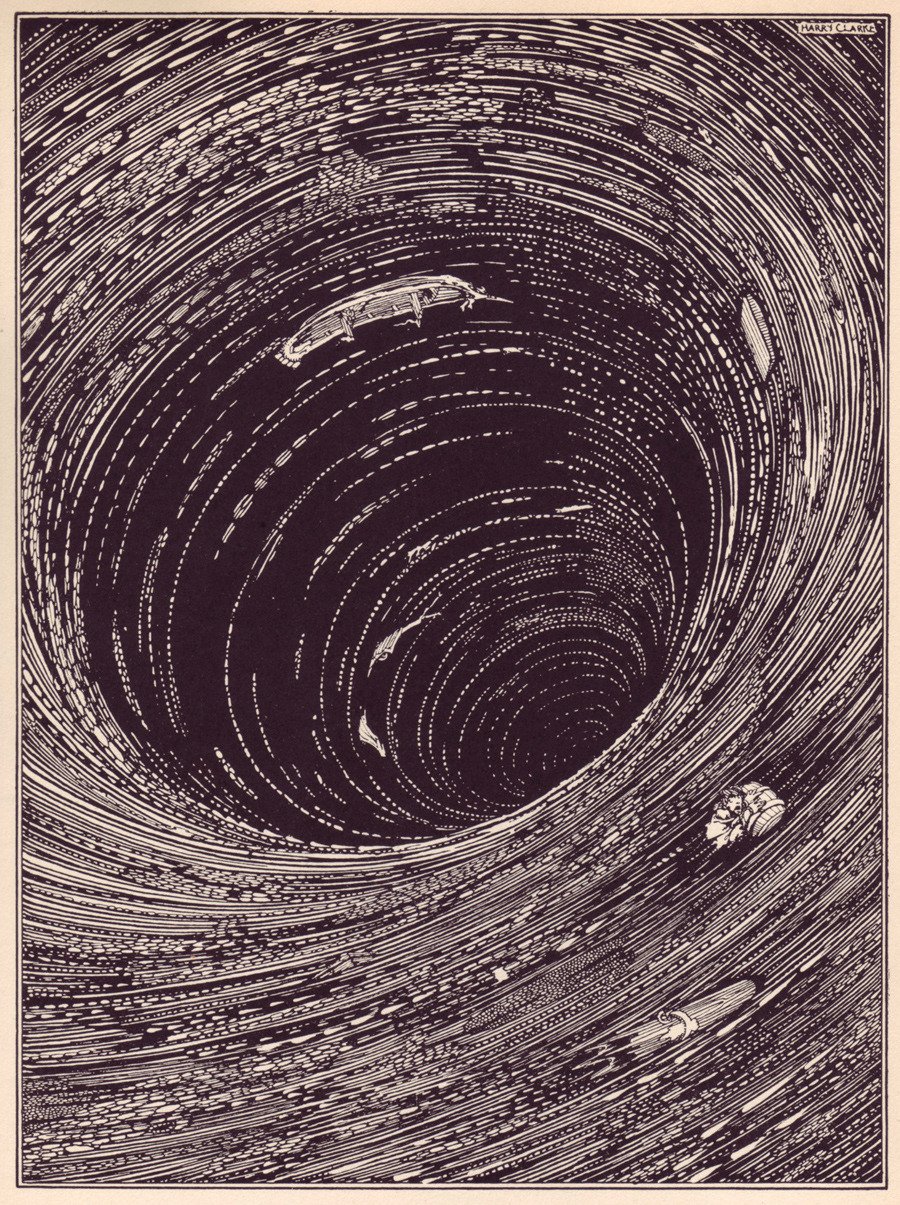
Descent into the Maelstrom, 1919, Harry Clarke (Illustration for the E.A.Poe story).
NOTES:
I am reading in particular the 1972 Penguin edition, edited by Harold Beaver, and whose footnotes are zany and weird, and zero in on the more gnostic and esoteric features of the text.
These days you can still find this idealism alive and well in evangelical Christianity for whom heaven is more real than our fallen earthly reality—the shadowlands as C.S. Lewis put it. And likewise, from a more secular view, our obsession with progress dreams of future transcendence and perfection in the AGI singularity. And yet, from another more granular viewpoint, the argument for the priority of the idea has far more ambiguity and nuance: for surely the acorn has an idea in it (in all those spiraling coils of DNA). But what kind of idea is it? And whose idea is it?
If Ishmael begins his narration as first person singular, once the ship is at sea, the narration weirdly shifts to ambient third person omniscient and shifts back again occasionally to Ishmael’s singular perspective and who then survives the novel’s catastrophic end. Aside from being something of an innovation in narrative fiction, together with making the book a multiplicity of unique perspectives, this oscillation between intra and intersubjective perspective seems to be adjacent to Ishmael’s ability to become oceanic, as happens periodically throughout the novel. It is as if his yes-saying were similar in kind to that peculiar kind of attention called for in psychoanalytic listening in which the various presumptions and judgments of mental cognition are evenly suspended, and the analyst’s unconscious tunes itself to the unconscious of the patient; for, as we all know, like the ocean, the unconscious only says yes. For better or worse, psychoanalysis began with experiments is thought-transference, and the idea of an ambient, or oceanic, psyche persists to this day in the more weedy corners of psychoanalytic research.