Trance-Media
Don Quixote dried his brains out by reading too many sword and sorcery books. He read so many of these books that he began to believe they were real. Far from assuming that this pathology is particular to him, on the contrary, don’t we all do this to one degree or another? Whether Manga, the holy bible, four chan, or CNN, don’t we imbibe our various medias, precisely for the pleasurable trance-states they put us in?
How am I drying out my brains with media, you ask? Mostly by reading lots of psychoanalytic papers. In this manner I project the necessary illusions endemic to my field. The transference neuroses, the unconscious fantasy, the weird retro-active visions, and all populated by unhappy persons, acting unhappily, and who appear now and then, in real life, sitting before me in the consulting room, asking for help.
When a patient complains to me about being cursed in love, I think, “Ah yes, the cunning repetition.” I am familiar with this curse already as it is well documented in the literature under the name of refinding the object. Here the otherwise smooth space of personal narrative is made irregular or uncanny, like a deja-vu glitch in the matrix, by a primordial compulsion that may not serve your best interests. Should you wish to find unconscious phenomena in your own life, look no further than when a situation repeats, particularly one that you don’t want—that is, a painful repetition.
For the most part Don Quixote does want. He is an aesthete, taking great pleasure from his knight errant literature and going out to find that pleasure in the world, in the form of windmills, barber’s basins and squalid roadside inns, all under an enchantment, cast from a distance by a powerful wizard. Don Quixote is usually given a bad rap as a crazy person, but as a model for how a person should be, his example has much to recommend it. He is resilient and lives a cheerful, passionate, meaningful life, devoted to justice, wandering the fields and forests of Spain and in a loving relationship with his faithful companion Sancho; just the kind of life, in fact, that is often described by the wellness industry and in the self-help books of today.
My own relationship to Don Quixote is asymmetrical and smacks of destiny. I took it upon myself to read this book when I was nine or ten years old. While I was largely underwhelmed by its content and only read the first few chapters—I wanted more actual dragons—the experience left such an impression upon me that I can still smell the book and see its old yellow pages and heavy old typeface floating in the air. One might say that this was my first intellectual encounter with fantasy depicted as fantasy. As opposed to the just regular fantasy that I had already been reading, such as Narnia or the Lord of The Rings.
Viewed retroactively we can see that there is a great deal of psychoanalysis in Don Quixote—all that pleasurable illusion; Freud too read this novel in his youth. Plus what’s more, the book offers a rather sophisticated theory of media. The media on display here, Don Quixote’s library of fantasy literature, has five qualities (but that probably apply to any media whatsoever). Trance-Media is:
Informative: The literature informs Don Quixote with an entire way of life.
Mimetic: This media is contagious and quickly pulls other persons into Don Quixote’s world where they join together in mutual intersubjective fantasy, as does Sancho Panza.
Pleasurable: Don Quixote is motivated by the manifest pleasures of this romantic literature (and that is no doubt mixed with the masochistic pleasure of his defeat).
Defensive: Don Quixote defends himself from the rapid transformations of capitalist take-off in modern Spain—not to mention his own senescence—by immersing himself in the fusty but immortal scenes of chivalric romance.
Trance-inducing: The literature produces a fully functioning simulation that operates at the level of an ecstatic trance, an altered-state combining both interior world and randomly encountered scenes from reality—a kind of 17th century virtual reality.
But even in the midst of this complicated woven matrix of fantasy and reality, Don Quixote, the book, is a work of consummate, even absurd, realism. The cruel world of early modern Spain will not let our hero knight get away with his lofty dreams. Don Quixote’s unfortunate repetition is that he is always getting beat up. If you add up all of his teeth that are knocked out in the novel, the number is more than the number of teeth in a typical mouth. Similar to Mike Tyson’s bon mot that, “everyone has a plan until they get punched in the mouth,” this self-perpetuating misery offers us a clue, a kind of reality principle and way out of the labyrinth—if, that is, we can recognize that there is one. In a world of illusion, the sign of the really true and real reality is suffering. Of course, this is made all the more tricky by the fact that many people, like Don Quixote, really enjoy their suffering.
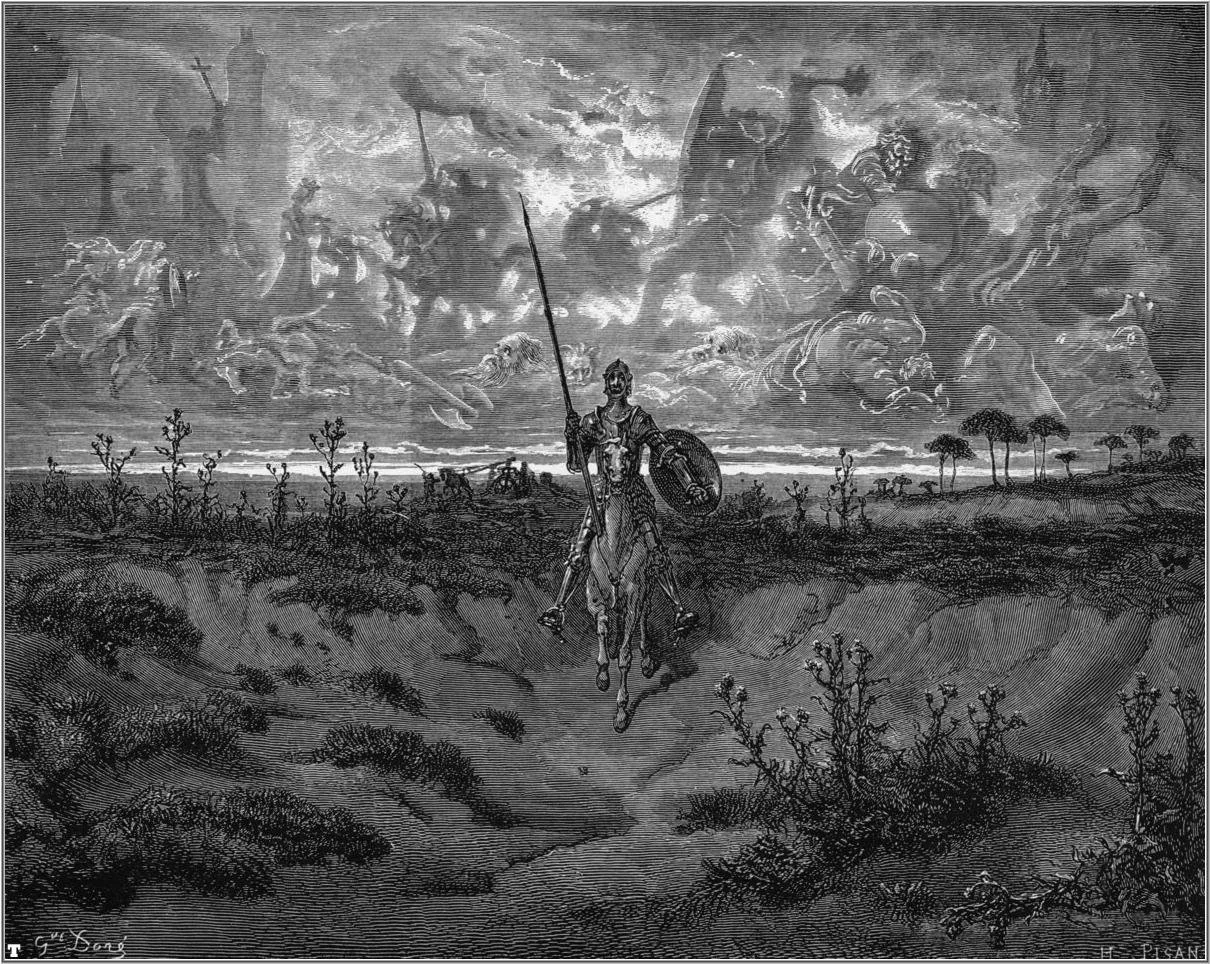
Miguel de Cervantes’s Don Quixote, 1863, Gustave Dore
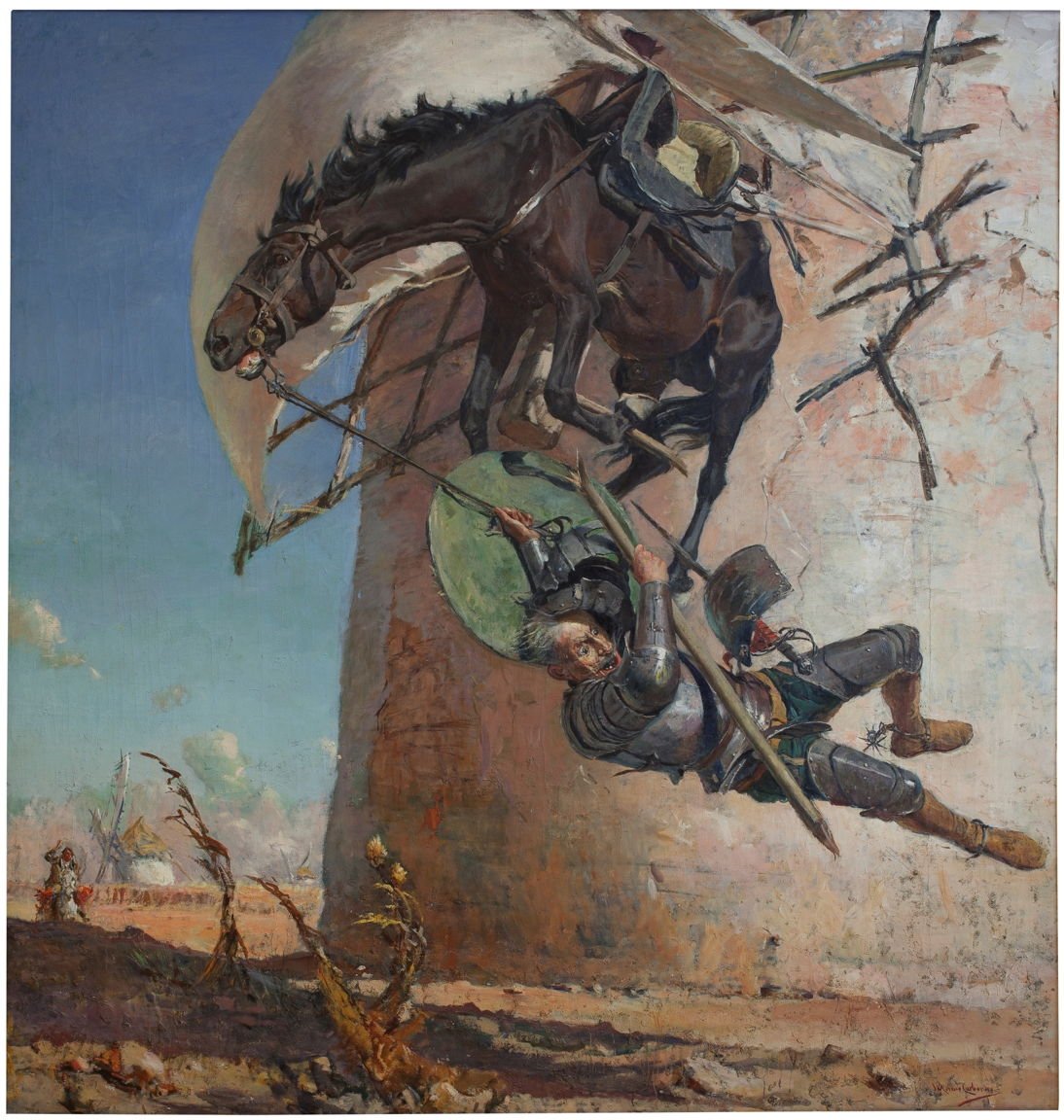
Don Quixote and the Windmills, 1900, José Moreno Carbonero