The Metabolic Unconscious: Death Drive as Metempsychosis
Freud can tend to draw a hard line on consciousness as in this passage from the essay The Unconscious (1915): “To-day, our critical judgement is already in doubt on the question of consciousness in animals; we refuse to admit it in plants and we regard the assumption of its existence in inanimate matter as mysticism.”
Certain philosophers and neuroscientists today have drawn this “critical judgement” so tight as to eliminate consciousness altogether. The hard problem of consciousness is just too hard! Because science can’t crack it, consciousness must not exist. See the pugnacious Danial Dennett for this kind of machine think. Meanwhile we are inventing machine intelligence at a furious pace and absurdly attributing to it all manner of spirit. Michael Pollen’s new book, A World Appears, published last month, offers an intriguing expose of the various knots science ties itself up in trying to account for this thing consciousness that everyone knows intuitively, without having to think about it. Far from denying consciousness, human or otherwise, Pollen, something of an animist in his own right, presents the thesis that life—any life whatsoever—is consciousness.
I’ll admit that putting a limit on spirit may be necessary for performing certain kinds of psychological inferences—that is, the scientist must draw the line on consciousness somewhere. In Freud’s view the limiting of spirit is a sign of maturation: the child lives in a world of spirit; the mature adult has sequestered this spirit to the realm of psychology. I, who do not believe in “maturation” (at least not in its old-world variety), remain unconvinced on this point. Meanwhile, Freud’s matter-of-fact certainty in denying consciousness to the non-human and inorganic remains highly dubious and has opened-up a trapdoor in his later theory of the death drive that I have unwittingly fallen into.
Beyond The Pleasure Principle (1920), in which Freud introduces his notorious death drive concept, is one of my school’s seminal texts, charmed as they are by the aggressive instinct, and I have had to read it for class at least five times. My own reading of this text follows Jean Laplanche for whom the death drive is the bottom end of the sexual drive, the tendency to zero; it is the annihilation inherent in ecstasy; being destroyed by love, to put it shortly. But over the course of my many readings of BPP I have arrived at a reading of the death drive that, while not invalidating Laplanche, stretches the tendency to zero way out into territory that Laplanche would dare not have visited. In other words, I read Freud’s text literally.
Freud admits his speculation is out there; “what I’m proposing is some really weird shit, but it’s based on sound psychoanalytic research” (I paraphrase: see note1).
The death drive speculation, in a nutshell, is this: “the aim of all life is death.” All life is driven by a desire to return to an earlier state of things, specifically a tensionless primordial state before life began—an inanimate state.
Laplanche, among others, warns that this is not to be taken literally, meaning, by no means should you read this biologically. It is not biological death, but rather the death of ego-organization; it is in the nature of sexuality to unbind the ego (note 2). I agree with this, but I also cannot help but take Freud at his word. If his text is not to be understood “metabiologically,” why then did he write it that way? The death drive is not the desire go to sleep, nor the desire for the womb, nor even a desire to die, but rather a desire to return to a state prior to life.
This is the trapdoor I’ve fallen through, the thought I can’t stop thinking: the desire to return to an earlier inanimate state implies that one was once familiar with such a state—lest how else would one desire a return there?
Familiar is perhaps not the right word for it. But the literal reading of the death drive is that the unconscious mind reaches all the way down into the inanimate earth. So the death drive becomes a speculation that, perhaps without Freud’s intention, extends a far way out into mysticism. And not just mysticism, but ye old panpsychism; the belief that matter is spirit. Lightly trodding along this line of thinking one gets the impression that Freud—closely following Goethe’s fascination with daemonic nature—is a closeted Spinozist (for whom God is a universal substance) (note 3). For all Freud’s attempts to confine psyche to the human mind he inadvertently spills it into the inanimate; the natura naturans; the spirit that lies dreaming in rocks.
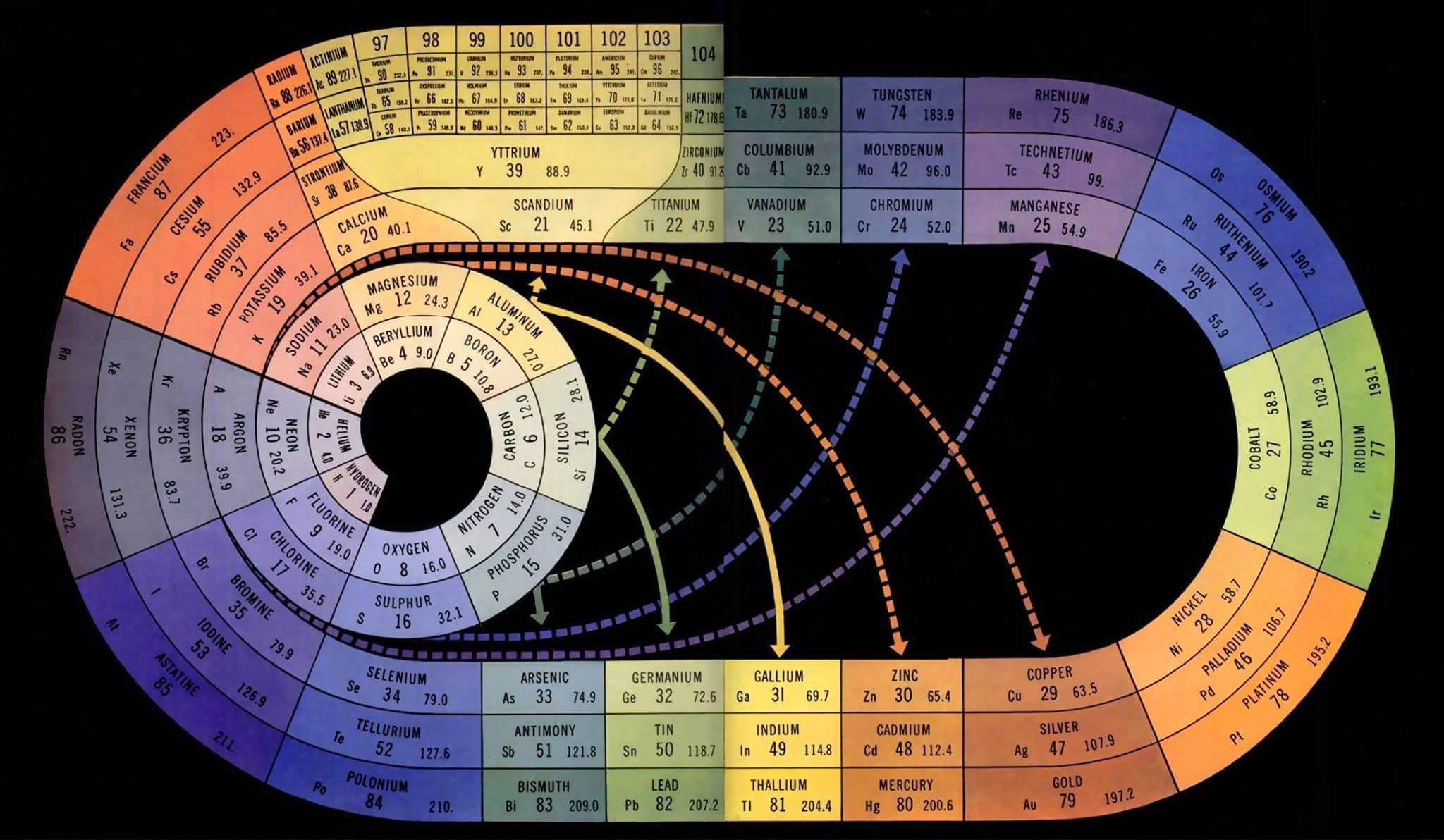
The metabolic periodic table in rainbows
Following his formulation of the death drive Freud will later admit, “I can no longer think in any other way.” This Zwang, or compulsion, likewise compels me to a similar exigent path by which I cannot shake the wild speculation (there are no facts here, mind you, only science-fictions) that the dynamo of sexuality is run by the gravity of the abyss; that we retain some degree of sentience on our journey into death, as many near death experiences report. This return of spirit to earth was known by the Greeks as the weird metempsychosis, the transmigration of souls—although I imagine this less as a soul, with its notion of fixed identity, than as generic spirit. In the position I am proposing here metempsychosis and sexuality form one continuous circuit—as they do, coincidently, in James Joyce’s Ulysses.
This is basically jouissance remixed for The Tibetan Book of the Dead, that ancient, imaginative text that makes a kind of Lonely Planet guide for the land of the dead, and which a priest will read over the body of the deceased in order to guide their spirit through the bardo realm: that intermediate zone of inanimate sentience—the pure luminous mind (note 4). From the perspective of Freud’s “metabiological” text of 1920 the Tibetan priest is presiding precisely over this metabolic return of the mind into its inorganic substrate. A return that Freud had also described before, in The Theme of the Three Caskets (1913), as a return to “the woman who destroys him,” a return to his first mother, the earth.
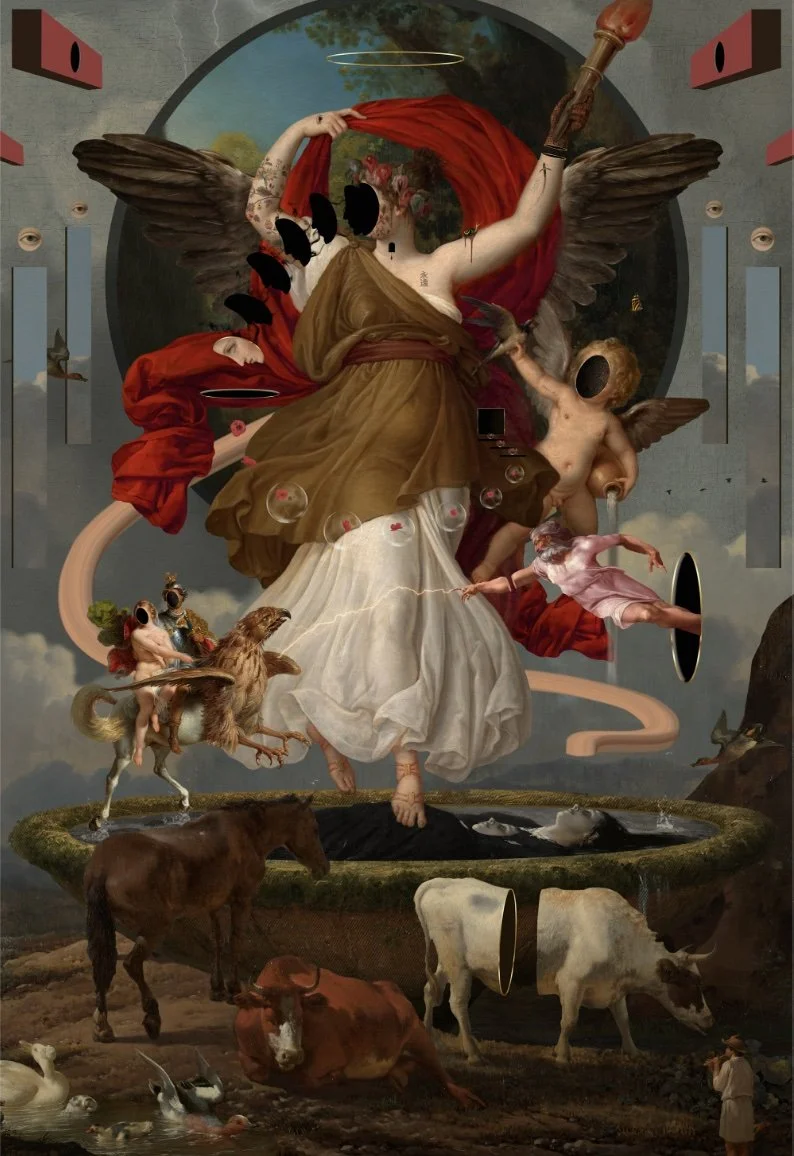
Metempsychosis, 2023, 1dontknows
Notes:
“The outcome may give an impression of mysticism or of sham profundity; but we can feel quite innocent of having had any such purpose in view. We seek only for the sober results of research or of reflection based on it; and we have no wish to find in those results any quality other than certainty” Beyond the Pleasure Principle, SE p. 37.
Laplanche points out that Freud had already speculated on this retroactive desire in The Project for a Scientific Psychology (1895) under the name of neuronal inertia. He raises this same backwards tendency again in the The Three Essays on the Theory of Sexuality (1905) now referred to variously as infantile sexuality and the polymorphously perverse.
“Spinoza indulged in pure sophisms; he was to be trusted least of all.” Freud to Silberstein, 1875
I happened to be reading The Tibetan Book of the Dead before I encountered its recital by Buddhist priests who sang it to the body of a deceased Japanese tourist at Tengboche Monastery in Nepal in 2005, where I had been hiking.