Psycho-Ecology
Not least among the visions of space in theories of early-childhood experience are those of Donald W. Winnicott. Following the hot internecine drama of the Controversial Discussions between the factions Anna Freud and Melanie Klein in the 1940s, Winnicott would later confess that he was confused by the whole argument and, rather than take sides, he retreated into the idea of environment.
Over a lifetime of thinking environmentally about early-childhood Winnicott, with the flourish of a Zen master, offers us two weird koans with which to be able to think—or un-think—the becoming-infant of this extraordinary moment. These two koans are:
There is no such thing as a baby.
Mother is an environment.
With these the famous dyad of mother and infant evaporates into pure environment. Both ambient mother, and non-existent infant dissolve into a magic zone. From this view it is more precise to refer, not to the mind of an infant, but rather the environment of an infant, an environment that is the mother.
If we add to that zone a libidinal economy—all that love and affection—mixed with the vital needs of the infant—the need to eat, to sleep, to be warm, plus the existential need to not fall off the planet—then we can begin to think of the infant less psychologically than ecologically. The dissolute infant and ambient mother coalesce to form an entire ecology—a psycho-ecology—and which, helpfully, includes its own laws, as they are known from olden days, the laws of conservation. Roughly these laws are:
Everything is open and continuous.
Nothing comes from nothing.
Everything must go somewhere.
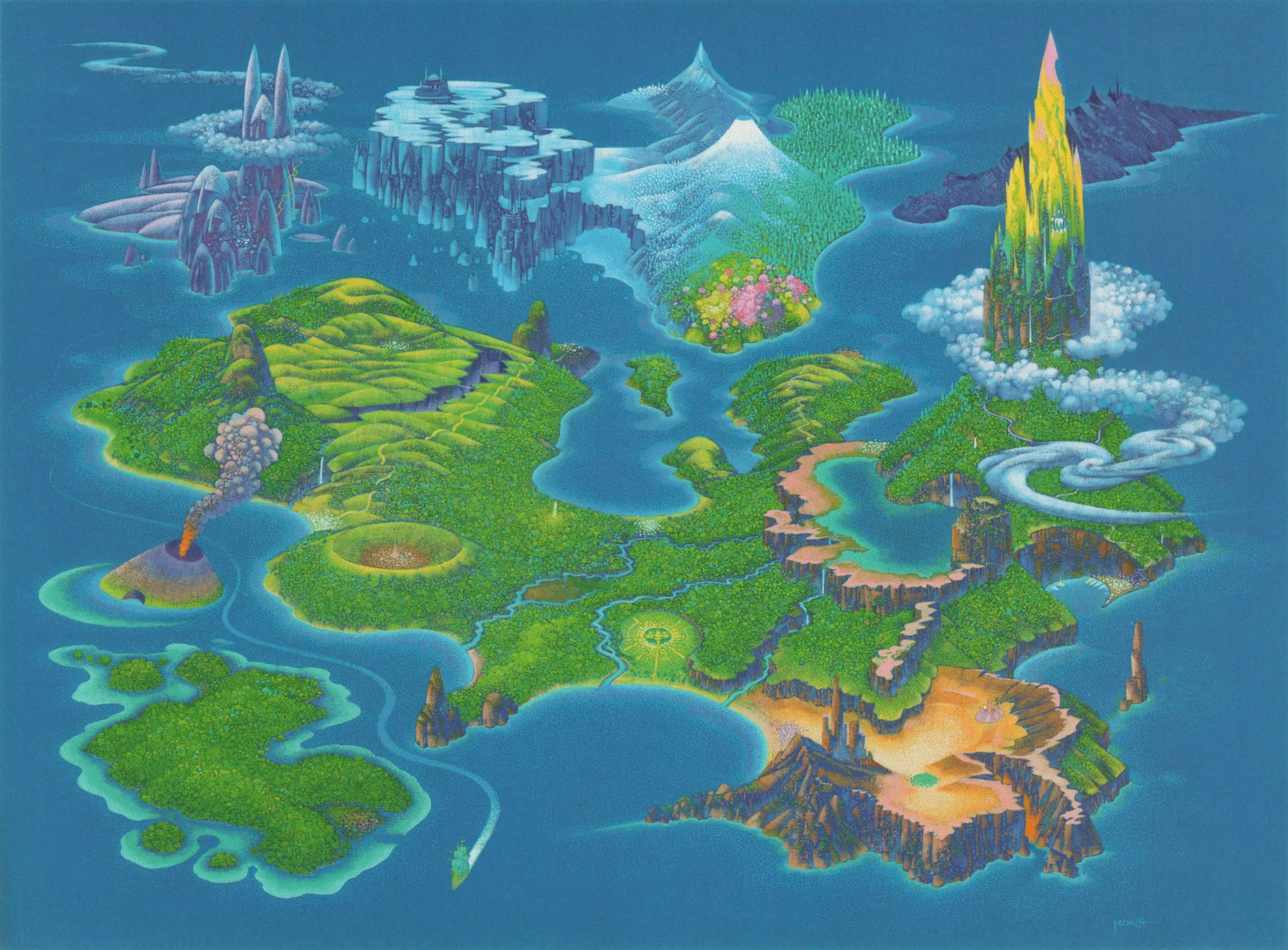
The psycho-ecology of the child viewed topographically, Hirō Isono
Notice that these laws are not so different than the logic governing Freud’s economic model of mind, as they are both ultimately derived from the same source: Lucretius’s year zero poem of Late Roman materialism: De Rerum Natura. Adapting these laws to the psycho-ecology of early childhood runs as follows:
Everything is open and continuous: mother and infant form a psychic continuum. Nor is there any separation between the infant and their immediate environment. This environment scales from domestic to socio-economic. What happens in the environment happens in the child.
Nothing comes from nothing: Just as the child has been made from the mother’s body, so the child’s libido, their drive, the psyche itself, has been given to them by their mother alone; or at least from that person who gives them the most love and attention. Psyche and libido are continuous between mother and child; they make up the metabolic flows of this ecology in a tea-cup.
Everything must go somewhere: Whatever is in the environment winds up in the child; even and especially the unconscious desire of the parent. Nothing is lost on the child; whatever happens to the child, even projections of their own fantasy (or the parent’s fantasies) for better or worse, become the foundations of psyche.
The subject never grows out of their psycho-ecology but rather barricades themselves against it in their rickety castle, the ego—just as we barricade against the outside world in our houses. The metabolic flows of intersubjective psyche are neither abandoned nor replaced, but always remain the greater environment against which the subject maintains an identity.
If a natural ecology is formed from the entanglements of flora, fauna and fungi, psycho-ecology is formed of the entanglements of intersubjective fantasy. As Freud notes in a footnote to Formulations on the Two Principles of Mental Functioning (1911), “phantasying” is isolated by the reality principle into a nature preserve not unlike Yellowstone national park.
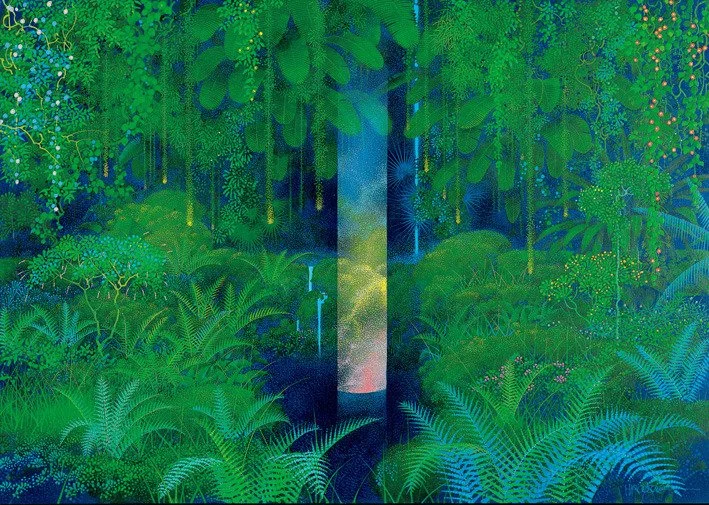
Forest Spirit, 1994, Hiroo Isono
Any given psycho-ecology is isometric to and nested within the greater planetary ecology; in the last analysis, we are this ecology. The Greek Oikos—home—is the root word for both ecology and economy and in my conception the homebound psycho-ecology is at once both determined by the socio-economic environment—whether growing up in a war zone, or a suburban home in Connecticut—and also determining of political economy, as in the old statement, the personal is political. In this case any given psycho-ecology is the most personal of human environments. Abuse in the home scales to abuse by the government.
Describing early-childhood as an open ecology is likewise a refutation of the all-too common myth that the infant is non-communicado, insensate to the world, encased within the “autistic shell.” On the contrary, if psychoanalysis has one public service announcement to tell the world it is that the child is radically open, of an acute consciousness, and far more cohesive with their environment than most will ever admit. In today’s world I would revise that PSA as: regard your child as if they were on the biggest and most profound of all mushroom journeys.
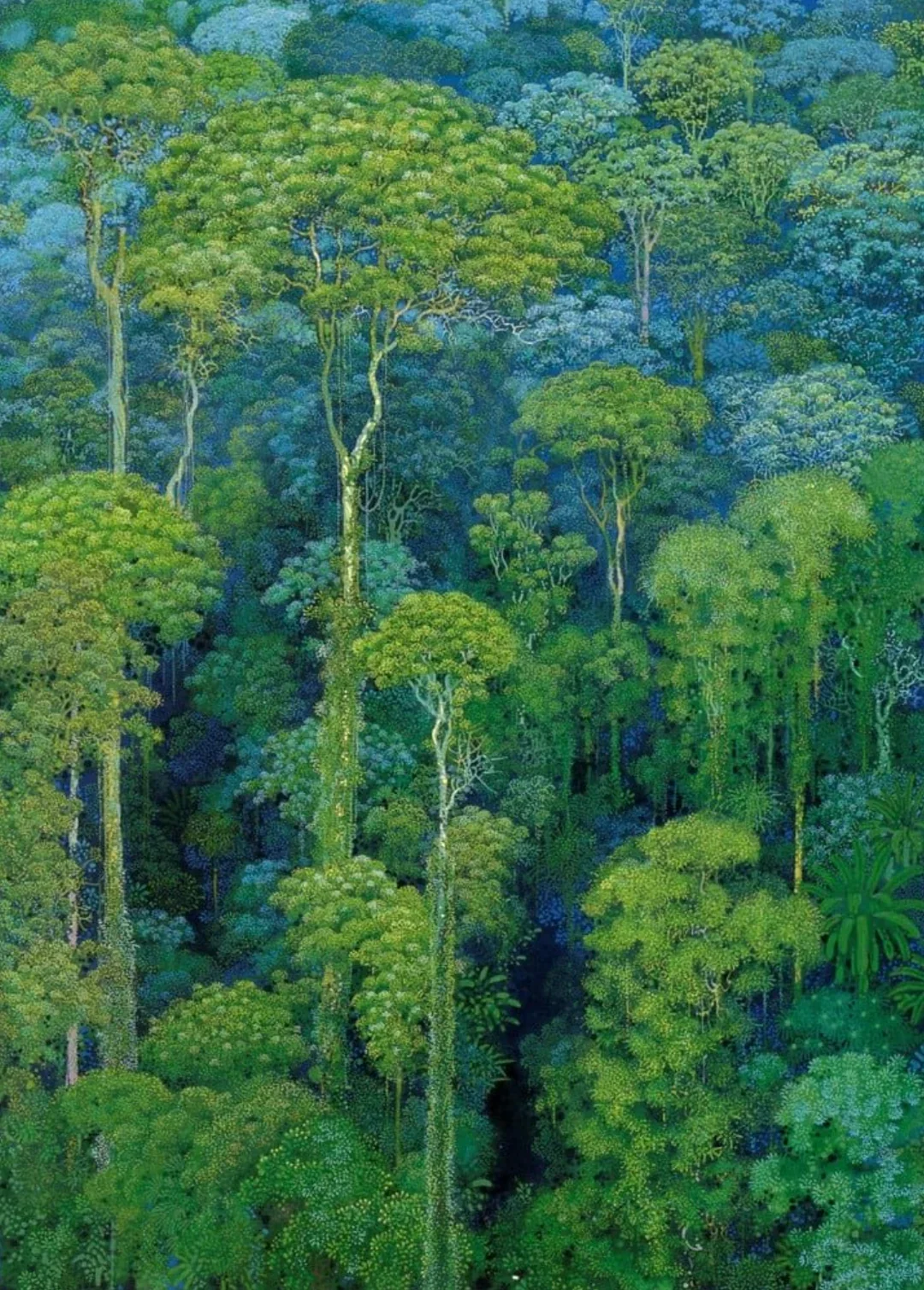
Forest Scene, Hirō Isono