More Human than Human
We often assume that a child is born into a state of nature. That the child is raised up, with good enough nurturing, into culture and society. Child Psychologist Edith Cobb, in her otherwise wonderful book The Ecology of Imagination in Childhood (1977), states this common assumption in plain language: the child is born an animal; the child learns to transcend the biological through the power of their imagination; the child grows up from a state of biology into cosmology. These assumptions are made under the auspices of a certain kind of Freudianism contingent upon instincts; that the unconscious is a seething cauldron of instinctual desire and that these instincts are inherently biological in origin.
This view is still very much at large, even at my school. But Freud proposed something rather different than this purely biological force and this is what is known as the drive. The drive is a force but it is not an instinct (note 1); the drive is non-biological. What the notion of the drive implies is that the child is not born an animal, but is born “more human than human,” if I may quote Rob Zombie. In other words the child is born into an imaginal “cosmology” that is scarcely imaginable to us, but whose emanations will in time animate every cosmology (note 2).
Because the child is born not into a state of nature but into a state of fantasy, what would be instinctual is immediately subverted (or perverted) by the love and affections from the adult caretaker and then confabulated by the extreme limits of the imagination. Infantile sensuality, what Freud named the polymorphously perverse, is mixed with an image, or a series images, (Note 3) and begins to be organized according to the pleasure/unpleasure series. While there may be object-instinct (note 4), in the sense that the child is searching for the breast as in the primal-crawl, the child is otherwise immediately immersed in a matrix of fantasies, of artificial cultural projections, that are both formed within the child, and that wash over the child, from the environment and from the adult caretaker; the child is born inventing, and has been thrown into a world of invention and these inventions, these giant cut-up fantasies at the scale of the cosmos, from within and from without, immediately begin to circulate throughout the child’s body in the form of drive energy, or libido. The needs of life, what the child—and everyone else—shares with the animal—the need to breath, to drink, to keep warm, the need to shit—are mixed with the love and affection of the parent and refracted into the most absurd degree of invention—even to the point of hallucination.
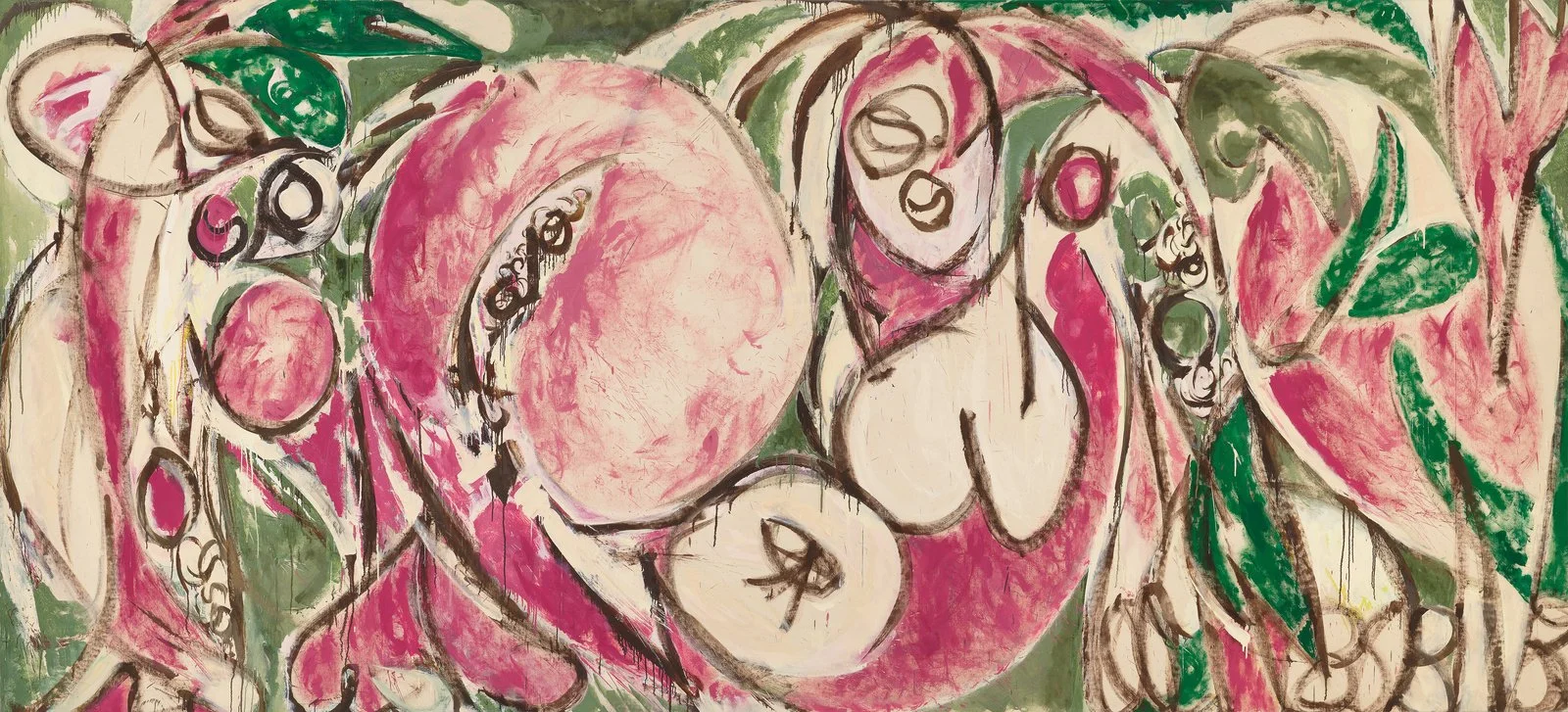
The Seasons, 1957, Lee Krasner
notes:
Technically speaking, Freud took care to maintain a crucial distinction between drive and instinct. Except that the distinction got lost in translation, literally so, and the subtle concept of the drive was subsumed under the wolfish instincts. This must be a resistance on the part of Freud’s translator Strachey but it is a resistance that Freud ultimately approved of… ? He will at times refer to the unconscious as a “nature preserve,” and these moments help to maintain the idea that the child is a little animal.
I say “cosmology” as a euphemism. Nothing so organized as a cosmology is forming here, nevertheless the hallucinations that the child is experiencing are cosmic, and they are immediately beginning to organize according to the pleasure/unpleasure series; the child’s fecund imagination will in time be the emanating force that determines the mature individual’s view upon the world, not to mention all of mythology, religion and metaphysics.
These images produced by the child are what Freud, very early on, named the thing. The Thing—Das Ding—is a direct allusion to the Kantian ding an sich—the thing in itself—and that is also known by Kant as the noumena; the hidden and unknowable reality of all appearances. To speak of a cosmology, is to retain some element of the Kantian sublime. The child had been subjected to what would become sublimity, always already. Lacan gives the most comprehensive and lucid exploration of Das Ding in his Ethics of Psychoanalysis seminar (1960) where it becomes the teeming void around which all signification takes place.
Psychoanalytic schools in which the drive is original, such as the modern school, both Laplanchian and Lacanian schools and classical Freudian, are opposed to the object-relational school on a disagreement (the so called controversial discussions) regarding the primacy of unconscious fantasy.