Psycho-Mythology
One of the guiding modes here at spacewhy is that of Freud’s forgotten concept of endopsychic perception, the visionary means by which the outward figurations of paranoia, myth and dream are read backwards to reveal a hidden psychical reality.
This strange idea was the nucleus of my master’s dissertation Nonduality in Freud, and you can read a long definition of it here. Even before discovering this concept in Freud, I had been deploying something like it since spacewhy began, prefigured in the name: space… why? and in the method of translating transcendence into immanence; of calling down the archon; of bringing the heavenly down to earth.
I postulate, but cannot at this moment prove, that Freud’s endopsychic perception is fundamentally Kabbalistic in nature. Either that or it is just an advanced form of Kant’s psychic apparatus that projects both space and time as synthetic a priori: the subject is a projection of the universe; the universe is what the subject projects. IMO this sums up ye grand old Psychology in a nutshell.
In relation to this concept Freud also spoke of psycho-mythology, coined in the same passage as when he first named the endosychic in a letter to best-bud Wilhelm Fliess dated December 1897.
Can you imagine what “endopsychic myths” are? The latest product of my mental labor. The dim inner perception of one's own psychic apparatus stimulates thought illusions, which of course are projected onto the outside and, characteristically, into the future and the beyond. Immortality, retribution, the entire beyond are all reflections of our psychic internal [world]. Meschugge? Psycho-mythology.
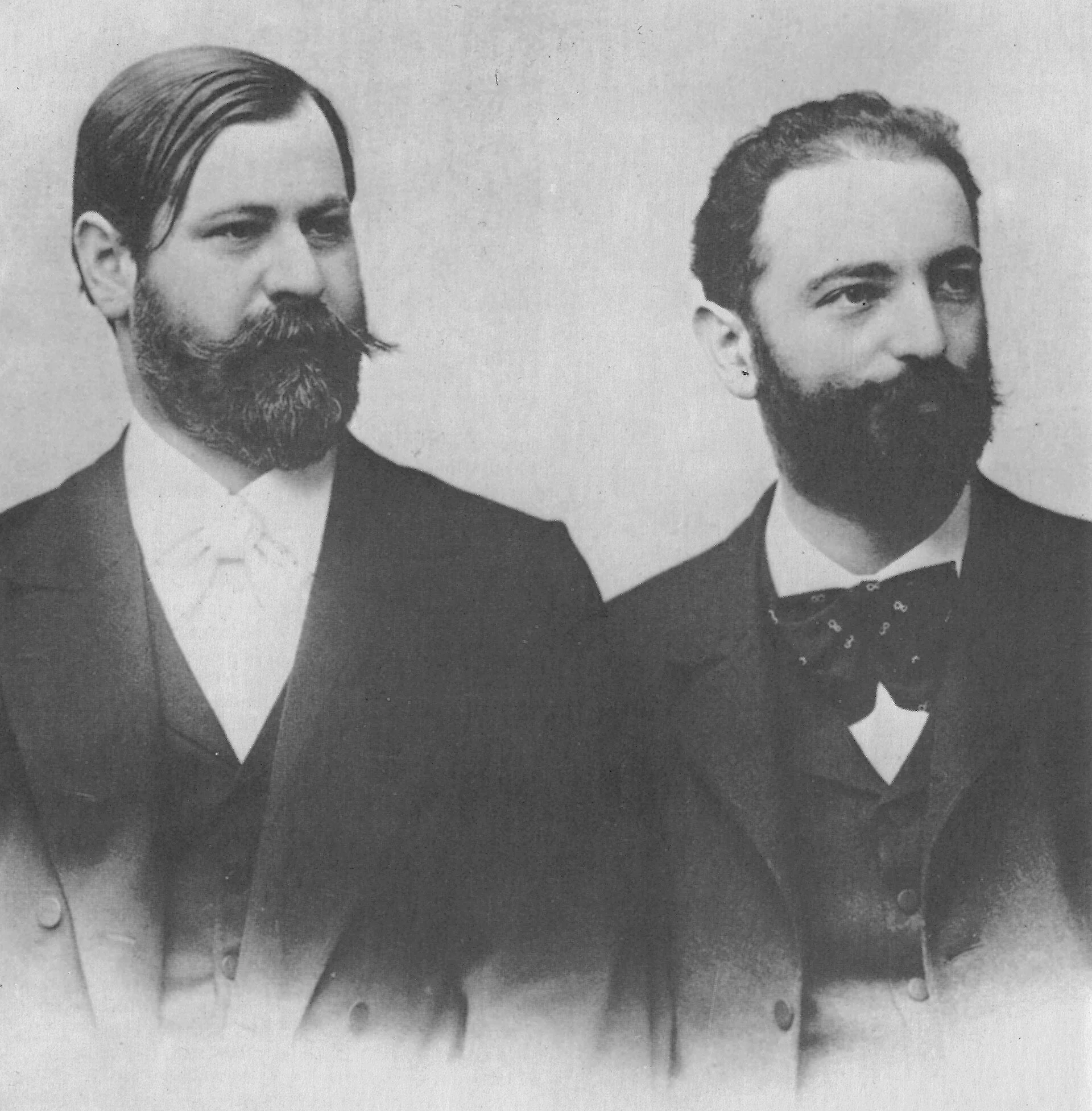
The BFFs
Meschugge!
The way that I think about this psycho-mythology is that all mythic and religious imagery the world over, all of the hundreds of thousands of gods, and all of the devils, and every angel and demon in between, the voids and the plenums, the tortures and the ecstasies, together with the seventh heaven, the bardos and underworlds and the very bottom of hell are all emanations of the fecund nature of early childhood psychic life. So that were you wondering what exactly was going on inside of the mind of an infant, you might look no further than the affective extremes of the visionary imagination—whether in a horror movie, or the realm of the blessed.
Carl Jung went running away with the idea of endopsychic myths and called them the archetypes; which you might recognize today in enneagrams and Star Wars. Psycho-mythology differs from the archetypes in the sense that the radiating emanations from early childhood psychic life are occult and unilateral and proceed in one direction. Whereas the archetypes are ready-formed and pre-stocked in the collective unconscious, psycho-mythology, on the contrary, is an emanation of what would otherwise be foreclosed and unknowable. To pursue the Kantian move, endopsychic myths are the phenomenal reflection of the noumenal abyss.
And yet Freud also understood endopsychic perception to be an instrument, not so different than a microscope or telescope, by which one might perceive a hidden reality; in other words it is empirical, just as much as it is visionary. In an extraordinary passage in Judge Schreber’s case, when Schreber is describing the “tendrils of god,” Freud claims that this is an endopsychic perception of nervous fiber. It is as if the Schereber’s schizophrenic paranoia is being used as a high-tech imaging machine with which to perceive the nuerophysical components of his own brain!
In a more mundane sense, this “obscure perception” is precisely the perception that the psychoanalyst has when listening to the patient describe the minutia of everyday life. So that, for example, when a patient complains to me how all of their friends are crazy and why oh why do they keep making friends with such crazy people!? then I have the hint of a clue as to what is going on, psychically speaking.
What remains highly weird about psycho-mythology is that it can be invented. We usually think that a representation obscures reality. And yet here in Freud this is reversed: an invented representation (a fantasy) is precisely what allows us to perceive an obscure reality!
Before you leap to the conclusion that this is hardly scientific, may I remind you of what Albert Einstein told Werner Heisenberg in 1926: “Whether you can observe a thing or not depends on the theory which you use. It is the theory which decides what can be observed.” This idea—that theory aids perception, that one must imagine it before one can find it in reality—would in time become the basis of Freud’s whole metapsychology. The theory of the drives is after all a “mythology'“ that allows us to observe an unknowable unconscious.
Most strange of all, in Analysis Terminable and Interminable (1937), Freud, faced with the inscrutable nature of the psyche, says, (quoting Goethe again):
We can only say: ‘We must call upon our witch after all!' —the Witch Meta-psychology. Without metapsychological speculation and theorizing—I had almost said ‘phantasying’—we shall not get another step forward.