The Stoned Ape Hypothesis
Far Out, Man
Ethnobotanist Terence McKenna imagined a far-out remix of the primal father myth and called it the stoned ape hypothesis. For McKenna, the great mystery of evolution is ourselves. While the theory of evolution does great work accounting for the mutagenic flux of general speciation, it fails to account for how humans became, well, so dang human. The fossil record indicates that human brains had doubled in size in a relatively short amount of time (note 1). What could have brought about this radical and unprecedented change? You guessed it: by repeatedly getting just absolutely face-meltingly zonked on high doses of psychoactive flora.
What follows should be read in the manner of science fiction.
The Hypothesis
Some hundreds of thousands of years ago during the middle-Paleolithic era, in a primal dawn not so far off from the one that Freud imagined, there lived in the canopy of the African rainforest small bands of proto-human hominins who lived as apes do, and who were ruled by a super-agro manosphere-type alpha-dude. A period of climate upheaval and desertification, not unlike what we are now experiencing, caused the rainforest to collapse and change over into the savanna grasslands that you’ll recognize in east Africa today. Forced into new habitat, the hominins began to explore new diets. What they found on the grasslands, growing from the dung of the ruminant cattle, was the magic mushroom—perfectly placed in order to advance the plot. They began to eat these magic mushrooms in great quantities.
Now the hominins, who up to this point had no language beyond grunting and shrieking, were so overcome by the synesthetic sensory combinations brought on by the psilocybin that they began to practice glossolalia, to experiment with new mouth noises that in turn produced wild synesthetic sensations and in turn lead to yet more articulate mouth noises, all the while being passed mimetically from speaker to speaker. And thus acute mushroom-induced synesthesia became language as we know it today, slowly at first, then all at once.
In the meantime the senses were enhanced; imagination exploded; social cohesion was improved; empathy expanded, meanings metastasized, brains grew in volume and general good vibes were on the rise. The erstwhile homo-erectus, who could merely stand up, had now become homo sapiens, whose thoughts grew to size of the universe. What had once been the toxic alpha male/primal father dissolved in the psychedelic solvent into the spaced-out, easy-going dad of a groovy new era. A lunar cult was formed to worship a horned goddess; lots of dancing ensued, and it was generally a pretty good party, at least until the invention of alcohol and agriculture. Then the mushroom was driven out of use, and the primal-father, that long-fanged alpha primate, emerged once more to rule society, as he does to this day.
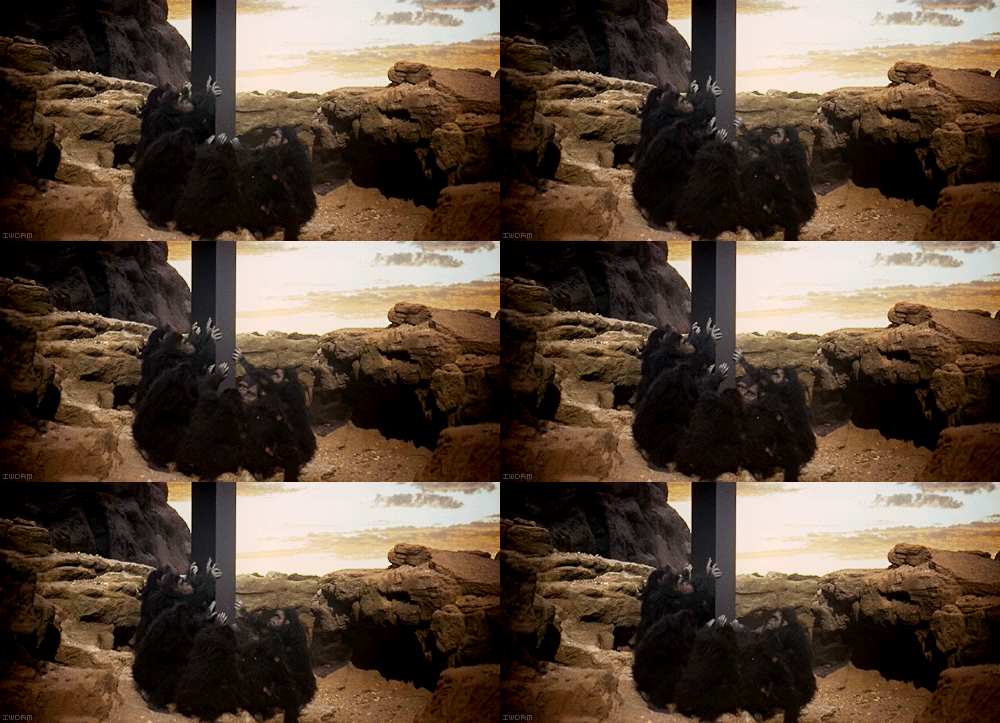
Screen Memories. Kubrick’s Super Panavision 70mm movie screen aspect ratio projected into the dawn of time; 2001: A Space Odyssey, 1968
First as Fantasy, Then as History
The biggest problem with this theory is that Joe Rogan likes it so much. For anyone who has been to there as many times as Joe Rogan has, such a theory must have an enduring and irresistible appeal.
I will neither confirm nor deny the stoned ape hypothesis but rather suspend it as an epic sci-fi screen memory.
If I had said last week that what begins as historical fact ends up as contemporary fantasy, I might just as well have said that what begins as contemporary fantasy ends up as historical fact. The fantasies of the present age are used as a device with which to peer into the primordial abyss of history and there find ready facts to support the fantasy. Whereas Freud had projected his own father into the dawn of time, McKenna projects his mushroom epiphany (note 2). And yet the similarities between Freud’s myth and McKenna’s hypothesis are striking. They both include a primal father and a primal hoard, and how eating a certain something kickstarted the advent of civilization—the eucharist is reflected here too. The main difference is the incest taboo: in Freud’s version the murder of the primal father begets the oldest and most universal of all laws. In McKenna’s version, however, the dawn of civilization is a giant orgy. 🤔
I tend to agree with the thesis of David Graeber and David Wengrow’s recent anthropological grab-bag book The Dawn of Everything (2021), in which, in the long skimble skamble of history, human society has been arranged in nearly any configuration you can imagine, so that any one narrative claiming ultimate truth—like for example that humans are fundamentally mercantile (read capitalist)—is but a fantasy that betrays the motives of its theorist (note 3).
A Primordial Conversion
As with so many persons who have undergone the psychedelic event, McKenna recounts his as an extraordinary conversion, as if he were Paul blinded on the road to Damascus. Where he once had been a rational materialist, following his epiphany, he would forever after proclaim a way out there weird naturalism mixed with hermetic idealism, in which “joining with the planet” would eventually produce the ability to “hatch from the chrysalis of matter” and journey into the stars as pure idea. So it’s only natural that he would project this radical transformation into the beginnings of time, where the brute animal was converted to humanity by the mushroom revelation.
In McKenna’s cosmology the advent of language some hundred thousand years ago is an event that is still happening now, accelerating in the eddies of a cataract pulling us towards the Transcendental Object at the End of Time. Which is just his zonked way of saying that we are each involved in a vast linguistic process whose end result is unimaginable.
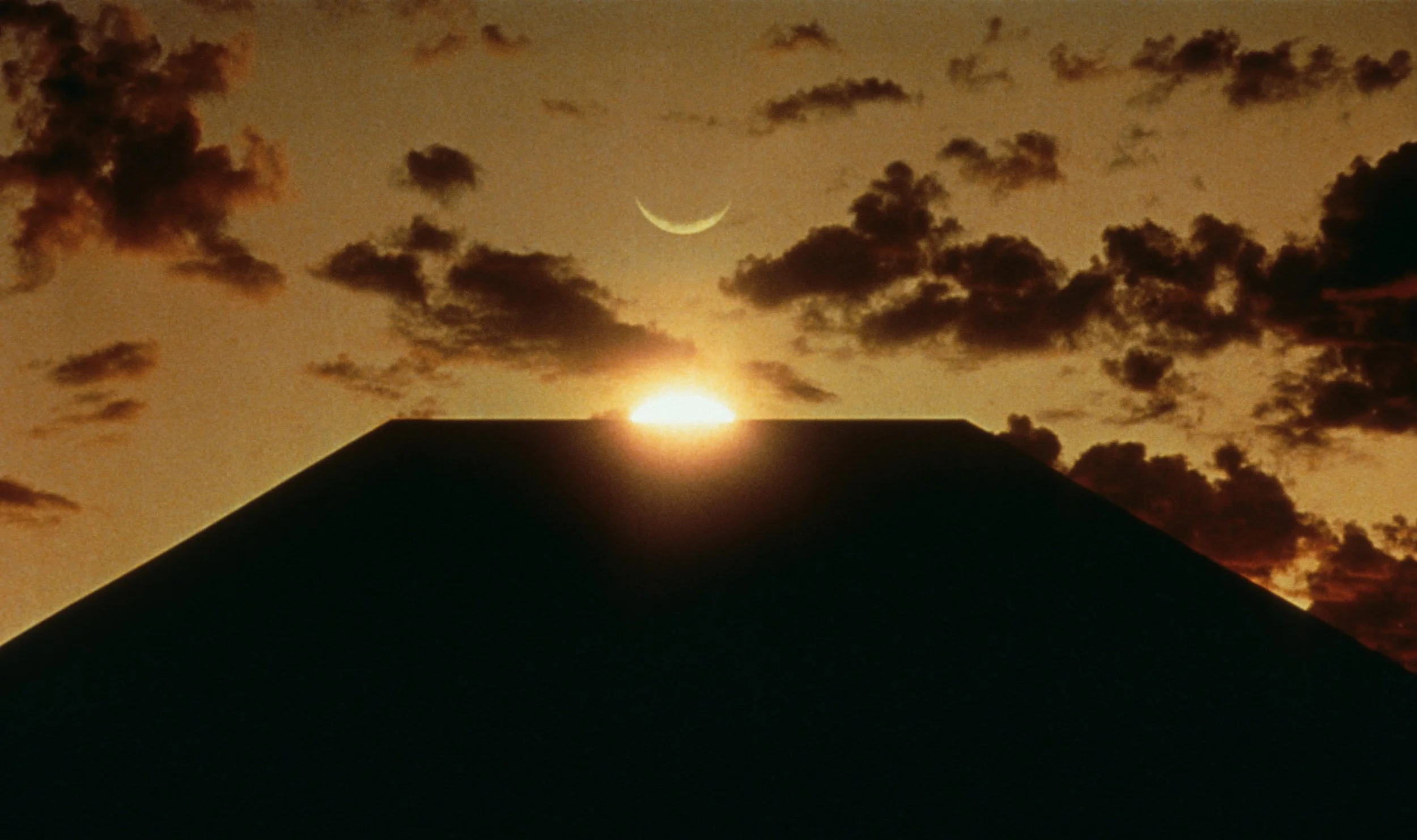
Black Monolith, 2001: A Space Odyssey, 1968
notes:
Evolutionary biology finds that species tend to stay the same for long periods of time, followed by sudden and rapid transformations. Radical changes in a species morphology are known in the field as punctuated equilibrium.
Yet another analogous projection of this kind is Kubrick projecting his preferred cinema aspect ratio—the exact dimensions of the wide face of the monolith—into the primordial origins of humankind in the opening sequence of 2001. The spirit of world history is Cinema.
Graeber and Wengrow’s thesis supports my own notion that reality is so insufficient, the human imagination is so fecund, and disavowal so functional, that anyone can basically conjure up any reality whatsoever to support their lunatic fantasies.