Eating God and the Myth of the Primal Father
Real Presence
Once upon a time I too went to church and took communion. I did so with a kind of dizzy fascination, understanding that I was in the presence of, at the very least, a powerful symbol, if not the actual Holy Spirit.
Being a student of literature at a Christian college, I had twice read George Steiner’s book Real Presence (1989) (note 1), who used Derrida’s post-structuralism to make the argument that while language is arbitrary and void of presence, the eucharist nonetheless guarantees a real presence in language. When I took the eucharist, I would try, with all of the fidelity I could muster, to really feel this real presence, and, truth be told, I would often fall into a serene and expansive mood. The magic appeared to be working.
Now that I am an apostate and no longer take the eucharist I am still no less fascinated by this strange ritual. What I find most curious now is the mysterious power that this practice held over myself and the congregation and likewise our near complete docility—I guess that’s why it’s called the flock. I, along with everyone else it seemed, possessed absolutely zero self-reflexivity as to why we were eating Christ’s flesh and blood week after week. It just seemed so normal; a mundane and sleepy normality that I now look back at in alienated wonder: I mean really? I did that?
Why? Wherefor? Inasmuch as Which?
Agonizing self-reflection is a principle mode of modernity and as it turns out a whole lot of big-heads began to be agonizingly self-reflexive regarding Christian rituals around the turn of the 20th century. Wherefrom came this most bizarre of contemporary rituals, they asked, and whither did it issue?
Freud too explored these question, psychoanalytically, in his great work of speculative anthropology Totem and Taboo (1913). Freud admits that religion is overdetermined and that no one explanation or origin can account for such complex belief systems. So while he carefully lays out the ethnological facts, he also offers a myth, an act of the imagination, as a means by which one might begin to think about what is going on here; this is the myth of the primal father.
Let’s Eat Dad
Curiously enough, in T&T’s last sentence (spoiler alert) Freud revised the famous opening of the Gospel of John, “…in the beginning was the word…” into its opposite: “in the beginning was the Deed” (note 2) The deed in question was no good deed, but rather, in the words of AC/DC, “dirty deeds, done dirt cheap:” this dirty deed was the murder of the primal father by his exiled sons, the primal hoard.
Deploying equal parts Darwin and Frazer, Freud concocts his myth, imagining that primaeval humans lived in small groups that were ruled, as with gorillas or horses, by an alpha male, the titular primal father, who collected as many wives as he was able to maintain and who jealously chased away all threats to his rule, including his own sons. No satisfaction was denied the primal father who, like the God of the Old Testament, or the president of the United States, did whatever he wanted to—because, well, because He’s the Primal Father. Soon however his many sons living in exile, no longer able to tolerate the degree of tyrannical indulgence, banded together and killed the father, and, in what can only shock the modern reader, tore him apart and devoured him.
Thereafter the sons were consumed with guilt and sought to atone for their crime with various rituals and prohibitions; the excesses of desire gave way to the prohibitions of the law; the totem ritual was instituted together with the incest taboo. Thus civilization began, gods became God, and neurosis became our common lot.
Lacan called this myth “the only myth the modern age was capable of,” and, linking it with the legend of Pan’s death, described the primal father as an “all powerful, half-animal,” almost as if he were describing Pan who, as everyone knows, has horns and the bottom half of a goat. Did the primal horde eat Pan?
Theophagy
Well, they ate something. Theophagy, the ancient practice of eating the god, was done far in advance of Christ’s request that his followers drink his blood and eat his flesh—a request that I still find to be rather grotesque whenever I hear it, but one that is made in most churches every Sunday morning. Christians are not usually described as cannibals and yet if the Catholic doctrine of transubstantiation is real then aren’t they? At the very least most Christians remain patently unaware of the larger, older and much weirder tradition that they happen to be stuck inside of, and acting-out, in pantomime, every week.
This is essentially the scandalous thesis of Frazer’s Golden Bough (1890), a book from which Freud took a great deal when formulating his primal myth, citing him at least 95 times in T&T. The armchair anthropologist Sir James Frazer, a near exact contemporary of Freud, and who claimed to have “never even seen a savage,” lays out a story common to humanity: primitive society in the age of magic, revered a vegetative god, who once a year during a spring festival was sacrificed as scapegoat and eaten. As it turns out eating god was something of a meme in that era leading up to the Last Supper, and Christ’s cannibalistic request was one that had been made regularly, far afield from early Christianity, and not only by Dionysius, that other rather goaty, Christ-like god.
For some reason The Golden Bough became a runaway best seller to the point where it seemed that everyone involved in literary modernism had read it: Yeats, Joyce, Elliot, Woolf, etc. I think that probably what was so captivating to the public upon the release of the Golden Bough was not only the dislodging of the eucharist from Christian revelation into immanent history, but also the transposition of the primitive “savagery,” by which victims were killed and eaten in sacred rights in the dim past, onto the now mundane ritual that believers performed every Sunday morning with rote devotion. Suddenly the barbaric past was a great deal closer to home.
The Inexorable Law of Ambivalence
Freud follows the anthropology of his era and links this practice of eating god to primitive totemism, in which the totem animal is deified and made sacred, and which, on special occasions, is ritualistically sacrificed and eaten, just as goats were for the Dionysian festivals. Today we still recognize the totem animal under the new age moniker: the spirit animal. For Freud the totem animal is the father. He makes this deduction from his own analyses of children’s animal phobias, such as little Hans and his fear of horses. Freud does Frazer one deeper by adding the myth of the primal father as datum and precedent to all of this ritualistic killing. The dirty deed that begat these sacred rituals becomes a kind of original sin common to all humankind (note 3).
Here is where time collapses in on itself, as it does so often in psychoanalysis, and the mythical crimes of remote primaeval antiquity phase shift into our own immediate unconscious desires. In the present moment, under “the inexorable psychological law of ambivalence” (note 4) do we not hate and love our father at the same time? Have we not, at one point or another, wished for our father’s death? Or was glad when he did die?
This collapse of history into the present moment is particular to Freud’s rather peculiar view of historical movement; for Freud, history proceeds crab-wise, in a kind of parallel process, first as historical fact and then as psychical reality; that is, what happened in deed at the primeval dawn of time, happens again, right now, in fantasy life; or, in particular, in the fantasy life of children, for, as you may have noticed, children can often loudly wish for their parent’s deaths.
Psychical Reality
Now one of Freud’s early discoveries, following the failure of his seduction theory, was that the fantasies of children had as great an impact upon psychic life as did real events. In my view the extraordinary imaginative power of early childhood fantasy is precisely psychotropic—and an order of magnitude more psychotropic than the fantasies of later life. If you’ve ever observed children under the age of five or six playing highly elaborate make-believe with imaginary entities, then you’ll know what I mean.
The child, subjected to the emanating rays of history as much, if not more so, than anyone else, mixes these with their fecund fantasy life to produce psychical reality (note 5). This is not reality per se but rather the reality of fantasy, and that may appear to us more real than any external reality. If later on in life a set of metaphors, such as the eucharist, is psychotropic—able to turn our mind, to induce a trance or altered state—it is the spiritual diorama of psychical reality that makes it happen.
In the last analysis Freud might well have agreed with George Steiner on the real presence of the host, but in this case it would be the ghostly object presence of your own father (note 6), as he appeared to you, larger than life, in the early years of your childhood…
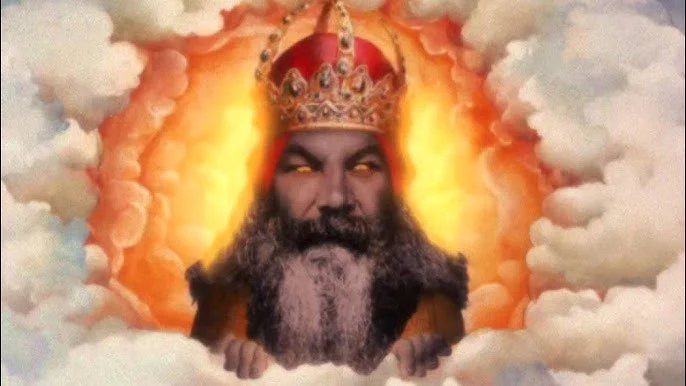
“Of Course it’s a good idea!” Father God, Monty Python and the Holy Grail, 1975
notes
George Steiner’s book was an epiphany for me, explaining post-structuralism in a way that was revelatory and that, despite its goofy Christian apologetics, nevertheless sowed seeds of systemic doubt in my mind that have since grown into a whole vibrant ecology.
Freud had the bad habit of often quoting Goethe. “In the beginning was the Deed” is, indeed, a Goethe quote.
From T&T:
“In the Christian doctrine, therefore, men were acknowledging in the most undisguised manner the guilty primaeval deed, since they found the fullest atonement for it in the sacrifice of this one son. Atonement with the father was all the more complete since the sacrifice was accompanied by a total renunciation of the women on whose account the rebellion against the father was started. But at that point the inexorable psychological law of ambivalence stepped in. The very deed in which the son offered the greatest possible atonement to the father brought him at the same time to the attainment of his wishes against the father. He himself became God, beside, or, more correctly, in place of, the father. A son-religion displaced the father-religion. As a sign of this substitution the ancient totem meal was revived in the form of communion, in which the company of brothers consumed the flesh and blood of the son—no longer the father—obtained sanctity thereby and identified themselves with him. Thus we can trace through the ages the identity of the totem meal with animal sacrifice, with theanthropic human sacrifice and with the Christian Eucharist, and we can recognize in all these rituals the effect of the crime by which men were so deeply weighed down but of which they must none the less feel so proud. The Christian communion, however, is essentially a fresh elimination of the father, a repetition of the guilty deed. We can see the full justice of Frazer's pronouncement that ‘the Christian communion has absorbed within itself a sacrament which is doubtless far older than Christianity.” Freud, 1913, SE Volume IX, pgs 154-155.
Ambivalence is one of the more handy and frequent terms in psychoanalytic toolkit and yet it does great work in obscuring the theory’s rather more shocking implications. Like for example, as opposed to love/hate, it would probably be more accurate to explicate the ambivalence we have to our father according to the rubric of the now popular drinking game: Fuck, Marry, Kill. I think that resorting to blanket ambivalence can dull or erase what is truly radical in Freud’s theory, as when Adam Phillips refers to the death-drive as mere extreme ambivalence. This erasure is in effect what Freud’s late dual drive theory accomplishes.
Psychoanalysis can accurately be described as the science of psychical reality.
Of cannibalism in psychoanalytic literature, it is Melanie Klein who takes the cake. In Klein’s grim mythology, it is, of course, the mother who is eaten in the fantasy life of an infant in the oral phase. In which case, the overly-prominent father in the above discourse is a kind of ruse, a “fresh elimination” of the mother. Would not the mother’s body, then, be the real presence of the eucharist?