Yes/And
Thinking According to And
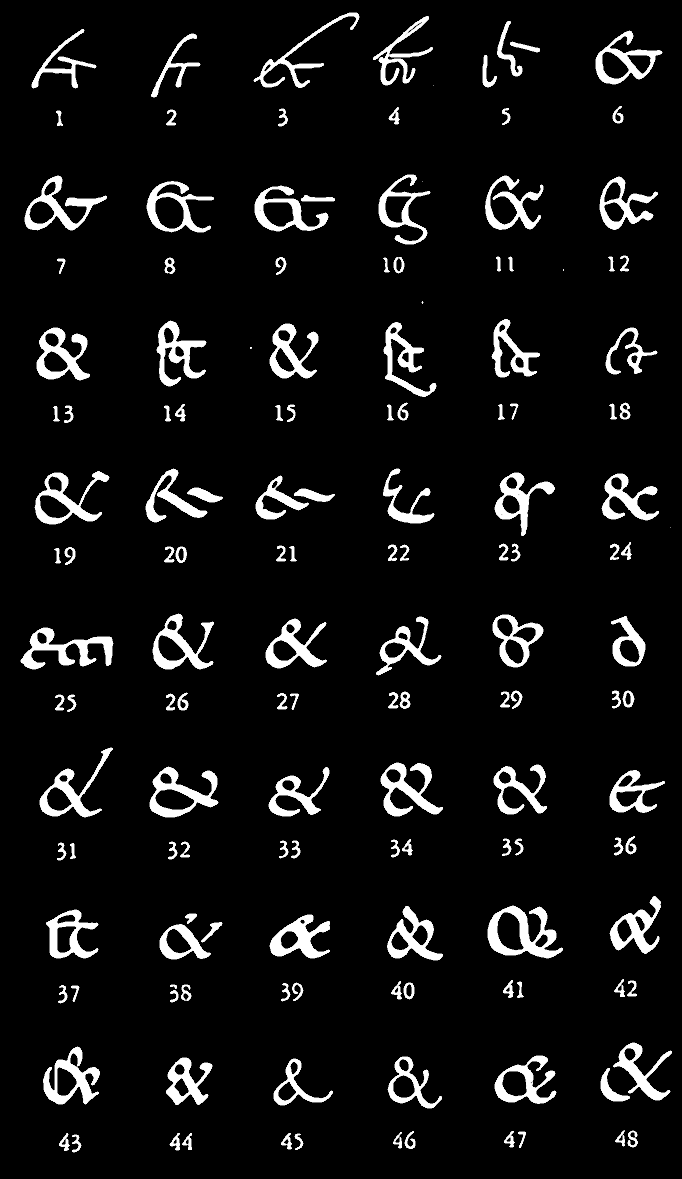
I have recently become rather obsessed with the ampersand, that strange and lovely typographical knot, the &. This is the only ligature that is still currently found on modern keyboards. A ligature is the combination of two letters that form one typographical unit. In the case of the ampersand these letters are e and t, or et, the Latin word for and, as in “et tu, Brute?” Julius Caeser can well imagine that his political opponents would murder him, but his political opponents and his good friend Brutus? That is too much. It is as if the et kills him.
This fascination with the ampersand is likewise a fascination with and. To state this fascination in the most abstract philosophical manner possible, thinking according to and replaces Kierkegaard’s dialectical binary either/or with the non-binary yes/and. As in, yes we are modern, and we are pretty medieval, and primitive too. Yes, you are determined in the last instance by a whole host of unfathomable contingencies, and you are responsible for your actions! And who cares about any of that when I have to bust my ass just to pay the rent?
A = A
The curious word ampersand derives allegedly from a latin name for this ligature meaning originally “and by itself and.” This makes me think of that tautological algebraic equation for the immutable identity of the One that we find in the mystical visions of Zeno, Plotinus and Laruelle; the equation is simple: A = A. Or as Plotinus put it: the mystical journey is the flight from the alone to the Alone. One travels along the path of the ampersand. Or the ampersand is the path. The Chilean psychoanalyst Ignacio Matte-Blanco finds this infinite non-logic in an unconscious that is ruled by indivisibility, where everything becomes mysteriously one thing; for, as we all know, the unconscious only says yes.
Body of the Ampersand
Anyways, I’d always been calligraphically curious, but now with my new-found ampersand obsession, I’ve become calligraphically active, using a parallel pen to draw an early medieval version of the ampersand over and over again; it’s very satisfying and I recommend it. The trick to calligraphy is all about posture and using your whole body. Letter forms are forms of the body; the ampersand is a sweep and a loop de loop made by your whole arm.
The Eschaton
Terence McKenna cutely referred to the ampersand as the eschaton. Here we might think of the and as the split atom, and the non-logic of the yes/and series is a chain reaction whose end is incalculable. The other way to think about this is that the so called “end of the world” is no end at all but rather a continuation into something that is heretofore unimaginable. The ands never complete, but merely continue on, indefinitely. Yes, it really is the end of the world, and the world will keep on going on! As McKenna liked to remind us, reality is not only stranger than you suppose, it is far stranger than you can suppose. This perhaps is the most radical form of and, the and as an inevitable advance into an unimaginable world, to which we are each of us all rapidly accelerating (and from which we all proceeded). So you can see how the yes/and series is rather terrifying and tantamount to psychosis; true reality is not reasonable, by definition.
and the Einfalle
And lastly, but by no means conclusively, we can see then how the movement of the and, this skipping and jumping, is the movement of the free-associative method—one that might be encouraged by your psychoanalyst with the intervention of a simple “…tell me more about that…”
notes:
In my entirely biased viewpoint the real alien in Spielberg’s E.T. are the misty pine forests the E.T.s land in. Trees are the supra-terrestrial aliens among us, producing and maintaining the livable habitat, if we only knew it, or cared.