Alien Psychosis
I find it rather amusing that my Christian parents were just as wary of aliens as they were of witchcraft; they frowned upon the E.T. movie as if it were blasphemy, for E.T. functions as Spielberg’s Christ, and likewise, such notions as other worlds threatens the androcentric cosmos, as Giordano Bruno discovered the hard way when, in the late 14th century, he proposed that each star had its own world and then was promptly burned at the stake for it—condemned in the name of Christ, I might add.
Here we can see again how that simple and, just the thought of other worlds, upends binary reasoning itself. Gods and devils are perfectly reasonable, they complement one another, dialectically, but gods, devils and aliens? That’s too much to think about. In this genre, a dialectical statement would be, for example: god isthe devil. A yes/and statement would be: yes, god is the devil, and the aliens don’t care.
On a related note, I’ve noticed recently the rise of a contemporary affliction that we will provisionally call alien psychosis, in which the alien or UFO becomes the transcendental signified of a paranoid fixation, leading to a break with reality: I witnessed an acquaintance succumb to this malady last year, and I see it periodically on the subway, and now James Franco is (maybe) a victim? Clearly Spielberg exercises his own alien psychosis by making so many movies about aliens (note).
Naturally, an obsession with the other in its most radical form belies the fundamental repression of the true alien, the alienwithin you. In this view the other world is the one that we already live in.
Yes, and illegal immigrants have every right to not be abused by the government as you and I do!
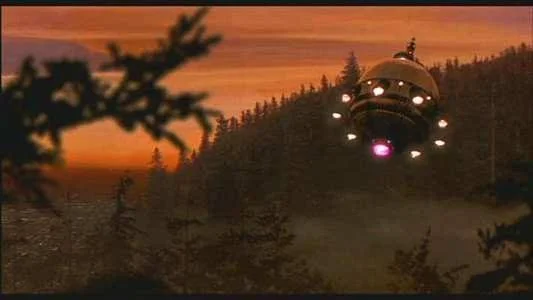
The E.T.s depart from our alien forest. E.T., 1982