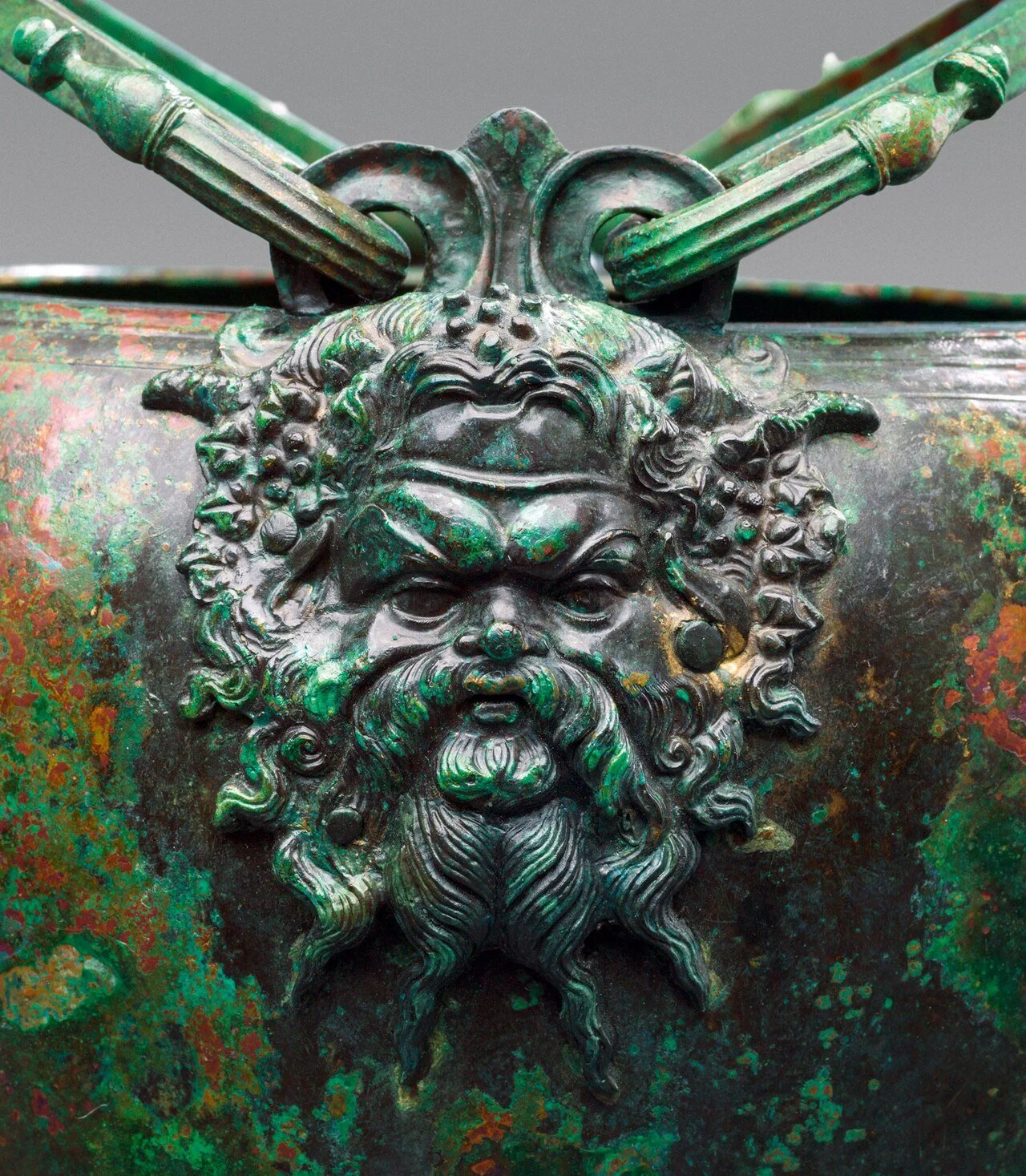
The Great God Pan is Dead, kind of
Plutarch, first-century biographer, priest of Apollo and general man-about-town, in his essay The Failure of the Oracles, recounts a curious legend: During the reign of Tiberius a sailor crossing the Ionian Sea heard a supernatural voice hailing him from the island of Paxi telling him to spread the news that “the great god Pan is dead.” The sailor spreads the word, to much wailing and lamentation. Pan, you’ll remember, is the god of wine and the wild, companion of nymphs, a nature god with horns and goat legs, and who presides over woods and fields, music and sexual excess; and who, despite having died, appears regularly in English romantic poetry. We can still find Pan’s influence in the English word panic, as in an excessive amount of energy overflowing psychic defenses causing a panic attack.
Since that time the legend of Pan’s death has taken on the aura of historical fact; because this curious event was near in time to the death and resurrection of Jesus Christ, Christian apologists have used it as proof of Christ’s victory over the demon gods of antiquity: they are still at it today.
Lacan, in his seventh seminar, making some rhetorical hey out of this legend, basically makes the same point as the Christian apologists do. The death of the god Pan is announced on the sea, according to Lacan, at the very moment when the temple veil is torn following the death of Christ. It is the moment when pagan jouissance—all that sex, drugs and rock n roll in the forests at night—gives way to Christian prohibition—all that chastity, hellfire, and self-laceration. But the death of Pan also marks the death of the gods in general and, for Lacan, reveals “the atheistic message of Christianity itself,” where Christ’s death is the death not only of the devil gods of pagan antiquity, but of any God whatsoever (for a rigorous example of this christian atheism, see one Slavoj Žižek).
Meanwhile, Lacan pokes Nietzsche as someone who didn’t hear the news of Pan’s death. Nietzsche, who had declared for all time that “god is dead,” had likewise in The Birth of Tragedy, revealed himself as “an initiate and disciple” of his god Dionysius. Dionysius and Pan are not identical in mythology but they often hang out with one another and they bear a number of similarities: each fond of music, the passions, pharmakeia, nighttime festivals, and those same remote meadows and glades. For Nietzsche to have vehemently declared the death of one god only to be found worshiping another is a classic example of psychoanalytic negation; that what is consciously denied may very well be unconsciously confirmed. The dead god is resurrected, or at least made undead.
Gods, like marvel cinematic universe characters, are supposed to be immortal, so that Pan should die is news indeed. Except that this would forget that even Dionysius, a proto-Christ-figure—called variously the son of god, the god of the vine, and the dying god—died once a year and was resurrected in spring. Like MCU characters, dead gods can be brought back to life in an instant, ready to star in the next movie. These days, the old gods, Pan included, are neatly turned into Jungian archetypes.
So it’s not without the same irony of negation that just as Lacan is confidently re-pronouncing the death of Pan in 1960, Pan was soon to have have something of a revival in the back-to-the-earth hippie movement, rock n roll festivals, and the rise of psychedelics. Gods and spirits can tend to haunt psychedelic experience; the mind-manifesting meant by the word psychedelic might be translated also as spirit-manifesting. Certain heads, such as G. Gordon Wasson and Carl Ruck—for whom the mystery in the ancient Greek mystery cults was psychedelic, and whose brand of psychedelic historicism is right in line with Nietzsche’s Dionysian zeal—found the contemporary names for these psychotropic alkaloids to be lacking in the sacred element. Forming a committee in 1979 of scholars and ethnobotanists, to choose a new name, they chose entheogen—generating god within. The name took off and, by my read, is in common use today and, among certain circles, even rather vogue.