Psychotropisms
psychotropism; noun: a metaphor that is psychoactive.
It continues to astonish me that the word psychedelic was invented only seventy yeas ago by two dudes in correspondence. How could this word, that now possesses an entire genre, together with a sordid cultural history, and that seems as old as time, have just been made up? But so it is. The psychiatrist Humphry Osmond proposed in rhyme in a letter to Aldous Huxley in 1956: “To fathom Hell or soar angelic/Just take a pinch of psychedelic.”
The translation from the Greek still rings true in a philosophical sense: to show the mind—or mind-revealer, if you prefer—and which fits in nicely when, later on, Stanislaw Grof described psychedelics as a microscope or telescope for the mind. Psychedelic is certainly the most handy word for these potent alkaloids but these days I find the word a bit stale and inadequate, not to mention highly stigmatized. I am of the strong opinion that psychedelic art is, for the most part, bad, and these bad-aesthetics have glommed on the term psychedelic and so given it the taint of raw kitsch. Likewise the high-weird seventies have imbued the word with some rather unsavory elements, MK Ultra and Timothy Leary not least among them.
The medicine women I have worked with refuse the word psychedelic and its attendant cultural language—such as tripping, or set and setting—on the grounds, I think, that this is the language of empire and erases a far older tradition. This makes sense to me, but I would also note that I am a child of empire and cannot so easily scrub my mind of colony. I grew up in psychedelia, so to speak; for example, I first learned of LSD from the song Lucy in the Sky with Diamonds from Sgt. Pepper’s Lonely Hearts Club Band (1967) which was one of the first cassette tapes I owned when a child.
In short, the word psychedelic is, as they say in my field, overdetermined, and I would prefer not to use it, if I can help it, although that is difficult.
Tryptamine is the most technically accurate name, referencing as it does the molecular structure common to psilocin, DMT, LSD, mescalin and so on. This term complicates our project as it also classifies melatonin and serotonin respectively and so scrambles the borders between exogenous and endogenous; tryptamines occur both within and without the body. This molecular structure likewise proves the rather extraordinary relations between the world of molecular biology and the extreme limits of the psyche, where a baroque alkaloid key (like toad venom) fits with impossible precision into our neurochemical tumblers (note 1).
The term tryptamine is given extra elan by the DIY biochemist Alexander Shulgrin, the “godfather of ecstasy” who, with his wife Anne, synthesized a staggering 150 novel compounds in their garage, and who co-wrote the now legendary TiHKAL, a cute acronym meaning Tryptamines I have Known and Loved (1997). Anne Shulgrin was a pioneer in developing MDMA therapy.
As I have written about before I think the term Hallucinogen should be banned outright. Curiously Humphry Osmond is said to have also coined this term in 1954; he certainly used it regularly. See the DEA website for the full effect of the hallucinogen bias.
I remain indifferent to the term entheogen, and I do not use it. If “psychedelic” is overdetermined, entheogen is determined right out of the gate by having that “theo” right there in the middle of it. Why, pray tell, must we pre-mix god into the psychedelic event? As I understand it this is an attempt to re-capture psychedelia from a gross and godless hedonism and to return the practice to a religious or sacred setting, that is, to re-institute the ancient practice of eating the god—or, as we are familiar with today, the eucharist.
This leads me to the rather gnarly idea at the heart of my project and which can be summed up under my own invented term: psychotropism; noun: a metaphor that is psychoactive. The common eucharist, as it is practiced in church every Sunday, whether Catholic, baptist or Lutheran, is a fine example of a psychotropism in action, where the body and the blood, in the form of wafer and wine or grape juice, administered by a priest or pastor to a congregation in a smokey dark chapel, is as I see it, mind-altering, in a very literal sense; in short, it’s trance inducing.
Of course, the name that science has for this phenomena is the placebo effect. The tryptamine, known likewise as a super-placebo, pushes psychotropisms out to their radical limits, where what is traditionally known as the set—in set and setting—is the set of metaphors, the fantasies, desire and mood, that you bring to the journey, both conscious and unconscious and that are then amplified and blown out of all proportion. In this event one may become overwhelmed by one’s own inscription; and yet it is also possible in this moment to re-inscribe a fantasy and that is why tryptamines have therapeutic potential.
The terms psychedelic, tryptamine, hallucinogen and entheogen are psychotropisms in their own right, each with the power to determine in advance the psychedelic event. It is probably the case that the feelings induced by any psychoactive substance, whether coffee, vodka, or Adderall, is greatly effected by its own set of cultural metaphors; coffee is a culture just as much as it is a chemical agent (note 2).
And yet psychotropisms are not confined to acid tabs and sugar pills, but are no doubt ambient in language itself—for language is also just totally arbitrary and made-up (note 3).
Freud mentions more than once the “magic of words,” as in the Introductory Lectures to Psychoanalysis: “Words were originally magic and to this day words have retained much of their ancient magical power.” I think this magic is psychotropic. On the one hand, a metaphor, or set of metaphors, has the ability to radically alter, or enhance, the manner in which we perceive what would otherwise be obscure (this maneuver is what Freud calls endopsychic perception {note 4}), and on the other hand, the more woozy implication is that daylit reality, as we know it, is a but fabric woven of invented psychoactive metaphors (the symbolic), and which is an old gnostic and kabbalistic idea, as in the quasi-gnostic opening of the Gospel of John: “…in the beginning was the word…” Ideology is a mesh of ideas from which we all get high.
Today we look in wonder at the ancient Greeks who had no word for the color blue. Could the Greeks even see the color blue if they had no word for it? The sky was not blue, but rather sky-colored and the wonderfully strange Homeric epithet “the wine-dark sea” is perhaps a clue that things appeared rather differently to them. To describe the ancient Greek mystery cults as psychedelic is a perfect anachronism, even if they were getting ripped on barley and ergot.
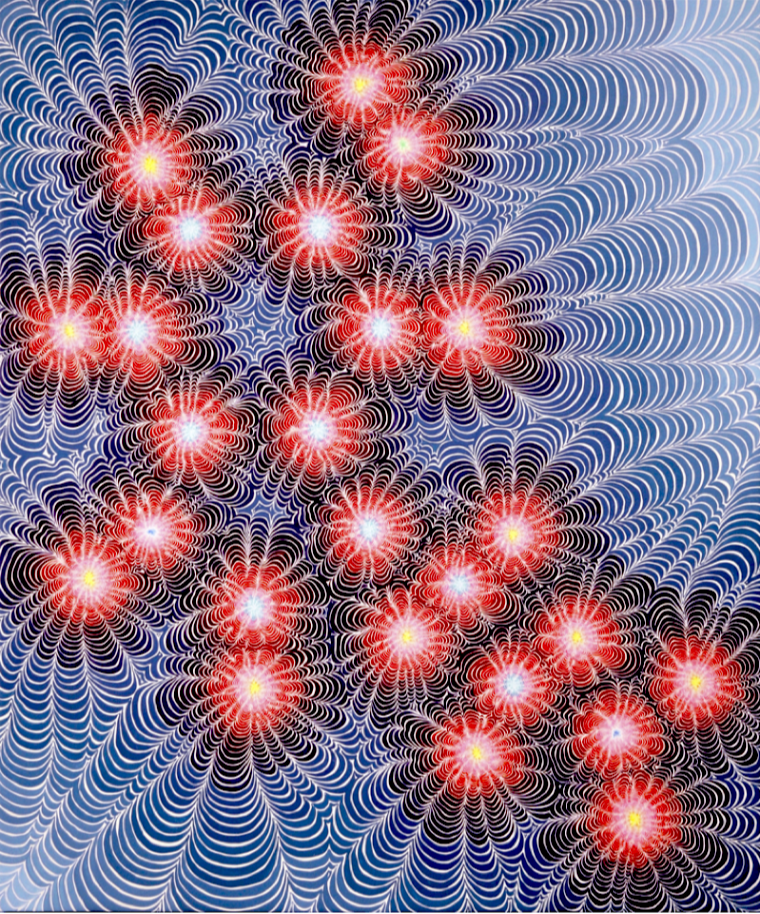
Serotonin, 2017, Kelsey Brooks
notes
A question to stump jurisprudence: how is it that DMT, an endogenous tryptamine that is produced naturally, not only in human brains, but in a wide variety of living creatures, is also a schedule one substance, the possession of which, in NYC, will get you sent to Rikers? By this definition, the brain itself is psychoactive, and illegal.
A history of oceanic feeling would be illuminating in this regard. This history would trace the oceanic metaphor from the American transcendentalist Emerson, to Nietzsche, Spielrein, Rolland, Freud and so on, continuing all the way to its present use in psychedelic research under the name boundlessness. How does this metaphor, likewise invented, determine in advance the feelings induced by these novel compounds?
I still find it difficult to fathom that any word whatsoever has, like the arbitrary term psychedelic, just been made up; all words are fictions that everyone accepts as real. This is, to my mind, the great discovery of Ferdinand de Saussure, founder of structural linguistics, that language, and by extension culture, is arbitrary, and totally constructed, word by word. And which makes our present moment rather precarious because we are really all just making this up as we go along down the bramble path of catastrophe. Couldn’t we make up a less cruel society?
In the long development of Freud’s thought, the very early concept of endopsychic perception would eventually become the metapsychology. From this viewpoint then, the various concepts of metapsychology, whether repression, sublimation, or the death drive, are also true psychotropisms: they are fictions that reveal an otherwise obscure psychical reality; they activate the unconscious.